The Fed held rates, inflation is still above target, and uncertainty is rising — that means the "buy anything AI" trade is over. Smart money is rotating fast toward the companies actually building AI infrastructure: chips, cloud capacity, and mission-critical data tools. Big Tech alone is projected to spend $635B–$665B on AI in 2026 — and not all of it is going where most investors are looking.
We've identified 9 AI stocks worth watching right now — including a lesser-known chip name tied to U.S. AI infrastructure, a cloud player with improving setup, and a data analytics company with government exposure. This isn't hype. It's about following where capital is actually being deployed.
Get the Free Report NowBy clicking the link above, you will receive this free report and a free subscription to the StockEarnings daily email newsletter. You are also agreeing to the terms of our Privacy Policy. Unsubscribe at any time.

Live Well. Invest Smart. No Apologies.
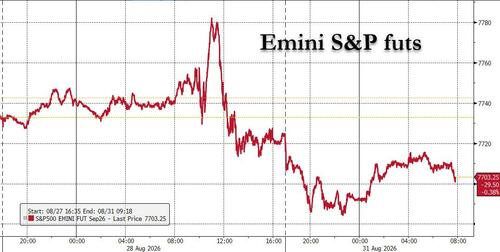
Image via ZeroHedge
Thin Tape, Big Moves: Futures Slide as Iran Risk Puts a Bid Under Oil
Month-end Monday opened with U.S. stock futures leaning lower in thin late-summer trading, the kind of tape where a headline can move the whole board because half the street is still trying to remember where they left the lake-house keys. The immediate catalyst was crude jumping on renewed Iran hostilities, a familiar pattern: risk-off in equities, risk-on in energy.
When oil spikes fast, markets don’t just reprice gasoline. They reprice margins, shipping, consumer sentiment, and the odds that central banks stay tighter for longer. The last day of August is a convenient time for desks to clean up exposure, and a sudden oil impulse gives everyone an excuse to de-risk at the same time.
The bigger story isn’t a red pre-market print. It’s what happens if higher oil sticks into September: energy becomes a tax, volatility returns, and the market stops rewarding “good enough” earnings quality.
🥃 Cole's Take: If your portfolio can’t handle a quick oil-driven drawdown, it’s not diversified, it’s just a collection of things you liked in calm weather. I’d rather own quality cash flows and a measured slice of energy exposure than chase the dip on the first scary headline. This is exactly why I keep dry powder and don’t run my risk budget like it’s a long weekend.
Strait Talk: U.S. and Iran Trade Strikes, and the Market Prices the Worst Route First
The U.S. and Iran exchanged strikes for the first time since July, and the rhetoric escalated fast, with President Trump threatening a strategic oil hub tied to the Strait of Hormuz. Oil pushed above $90 a barrel as traders focused on the one thing that matters in the first hour of a geopolitical flare-up: supply risk and shipping lanes.
Hormuz isn’t just a map label, it’s a pressure point. Even the hint of disruption makes insurers, shippers, refiners, and speculators reach for higher prices because the alternative scenario is ugly, fast. The market isn’t saying the worst outcome is guaranteed; it’s saying the cost of being unhedged into the worst outcome is too high.
If tensions linger, you’ll see it in more than crude. Freight rates, airline costs, industrial input prices, and inflation expectations all start to creep, and that feeds directly into rate-path assumptions.
🥃 Cole's Take: I don’t trade war headlines, but I do respect chokepoints. If oil stays north of $90, it will leak into everything from grocery bills to the Fed’s tolerance for easing. This is a moment for disciplined hedges and position sizing, not panic selling or macho bets.
📎 CNBC

Image via Yahoo Finance
Goldman’s Oil Reality Check: Higher Energy Isn’t Just a Chart, It’s a Growth Filter
Goldman Sachs delivered a blunt message on oil and the economy: energy prices matter, and when they move sharply, they don’t stay contained in the energy complex. The bank’s framing is simple: oil can behave like a broad tax on consumption and a margin squeeze on businesses, especially if the move is driven by supply risk rather than booming demand.
What investors often miss is timing. Equity markets can shrug off a one-week spike, but if higher crude rolls through a couple of CPI prints and starts changing corporate guidance language, the multiple compression can come fast. The “soft landing” crowd tends to talk as if energy is background noise; Goldman is reminding everyone it’s still a leading character.
This is also where positioning matters. When consensus has been leaning one way on inflation and rates, a persistent energy move can force a messy reset across bonds, growth stocks, and credit spreads.
🥃 Cole's Take: I don’t need a bank note to tell me expensive energy tightens financial conditions, but I do listen when the biggest desks start speaking plainly. If you’re heavy long duration growth and light on inflation-resilient assets, you’re effectively betting this oil move fades quickly. Build a portfolio that can hike uphill with a full pack, not one that only performs on flat trail.

Image via GOLF.com
Ruoning Yin Wins in Boston, and You Could Feel the Weight Come Off
Ruoning Yin is back in the winner’s circle after an emotional victory at the FM Championship in Boston, snapping a two-year winless stretch. The talent was never the question; the grind between trophies is where careers are either forged or quietly drift.
Winning again after a long gap is a particular kind of relief. You don’t just beat the field, you beat the noise in your own head, the second-guessing on every decision, the feeling that the next putt somehow carries the last 24 months. In a sport that gives you plenty of time to think, momentum is a real asset.
For fans of the women’s game, it’s also a healthy reminder of depth. The LPGA doesn’t hand out wins; the field is too strong, and the difference between top-10 and first can be one smart miss.
🥃 Cole's Take: Golf is the cleanest mirror I know for investing: process, patience, and emotional control. Yin didn’t reinvent herself; she stayed in it long enough for the work to show up on Sunday. That’s the same mindset that keeps you from blowing up a portfolio after a bad quarter.
📎 GOLF.com

Image via Car and Driver
Why Lamborghini Names Feel Like Myth: There’s a Library Behind the Bull
Lamborghini’s naming tradition isn’t just marketing swagger; it’s research. When the time comes to name a new model, the team in Sant’Agata Bolognese turns to dedicated bullfighting books, pulling from bloodlines, legendary bulls, and the culture surrounding the ring.
It’s a surprisingly analog process in a world obsessed with AI-generated everything. Names carry narrative weight, and Lamborghini understands that buyers aren’t just purchasing horsepower, they’re buying a story they can repeat at a valet stand. The brand’s consistency over decades has built a kind of linguistic equity that most companies would kill for.
There’s also a lesson here for anyone building a premium brand: heritage is an asset, but it has to be curated. Random names don’t age well; grounded names become part of the product.
🥃 Cole's Take: The older I get, the more I appreciate businesses that protect the details, because details are where pricing power lives. Lamborghini’s books are a metaphor: do the unglamorous work that reinforces the mystique. In markets and in life, the winners aren’t always the loudest, they’re the most consistent.

Image via Robb Report
A Gold-Drenched 1953 Cadillac One-Off Hits the Block, and It’s Pure Postwar Confidence
A one-of-one 1953 Cadillac “Elegante” concept, drenched in gold accents and period optimism, is being offered for the first time in 73 years through Kruse Auctions on September 5. It’s the kind of artifact that reminds you America once built dream machines with no apologies and plenty of chrome.
Concept cars are time capsules. They capture what designers thought the future should look like, not what accountants would allow in mass production. When one survives intact and stays in the same hands for decades, it becomes less a vehicle and more a movable piece of industrial history.
For collectors, scarcity is table stakes; provenance and story are the differentiators. This Cadillac has both, plus a level of theatrical presence modern cars often trade away in the name of efficiency.
🥃 Cole's Take: I like collectibles the way I like alternative assets: only after the core portfolio is healthy and liquid. But if you’re going to play in this lane, buy singular objects with real provenance, not trendy replicas with a hype cycle. The best “investment” here might be the joy of owning a piece of history you can actually roll into the sunlight.
That’s the brief. Keep your risk tight, your whiskey neat, and your next move deliberate. See you out there.
— Cole Hargrove