The market is dumping 7 blue-chip stocks based on lazy headlines — and that's your window. A healthcare giant that quietly raised guidance twice this year. An entertainment titan that just posted $346M in streaming profits. A software company with $5B in AI-driven recurring revenue. The crowd sees problems. Smart money sees mispricing — and the gap between perception and reality right now is as wide as it gets.
When sentiment shifts — and it always does — the snapback will be violent. These 7 stocks are identified, the thesis is built, and the free report is ready. The only question is whether you're positioned before the crowd catches on.
Get Your Free Report NowBy clicking the link above you agree to receive emails from Trading Tips and our affiliates. You can opt out at any time. Privacy Policy

Live Well. Invest Smart. No Apologies.

Image via RealClearMarkets
If rates alone killed bull markets, we’d be in a crater already
The clean narrative is that rising rates automatically mean falling stocks. It sounds neat, it sells clicks, and it gives people something to blame when the tape turns ugly. But historically, the market doesn’t usually peak because rates are rising; a lot of major tops show up after rates have already stopped rising and start easing.
The more useful takeaway is what that implies about psychology and positioning. Tight money can slow an economy, sure. But the market typically breaks when expectations and liquidity collide: earnings roll over, credit spreads start talking, and investors realize the “safe” growth assumptions were built on sand.
If you’re watching rates, watch them like a pilot watches weather: not as the sole cause of a crash, but as a set of conditions that can turn a small mistake into a catastrophe. The real risk is when everyone thinks the Fed is coming to the rescue and piles into the same trades at the same time.
🥃 Cole's Take: Rate panic is a lazy substitute for doing the work. I care less about whether rates are up 50 basis points and more about whether fundamentals are deteriorating while leverage is still high. When the market finally tops, the headlines will say “rates,” but the autopsy will read “positioning, profits, and credit.”
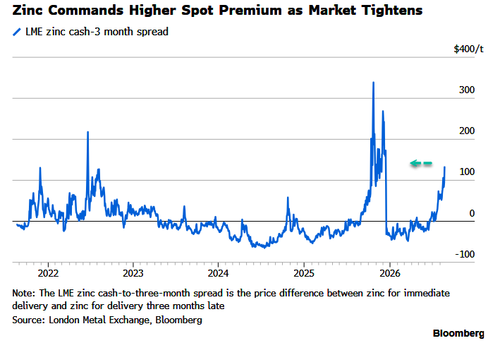
Image via ZeroHedge
Zinc is whispering “squeeze”, and industrial metals don’t whisper for long
HSBC is flagging signs of tightness in the global zinc market, and that’s not a throwaway note. Zinc sits in the unglamorous middle of the supply chain, but it’s everywhere: galvanizing steel, infrastructure, autos, construction. When zinc gets tight, it tends to show up in pricing power and downstream cost pressure sooner than most people expect.
Tightness usually comes from a familiar cocktail: constrained mine supply, smelter dynamics, inventory drawdowns, and demand that doesn’t roll over as quickly as models assume. And unlike some commodities that trade mostly on sentiment, zinc has a habit of snapping when physical availability gets pinched.
Even if you never trade the metal directly, zinc matters as a signal. It can hint at underlying industrial activity, and it can feed into the inflation conversation in a way that hits real businesses: manufacturers, builders, and anyone with a lot of metal in their cost of goods.
🥃 Cole's Take: I don’t chase commodity headlines, but I respect tight physical markets because they don’t care about your macro thesis. If zinc is truly tightening, I’m watching miners, smelter-linked names, and any industrials that have weak pricing power. The play isn’t bravado; it’s disciplined exposure and a quick trigger if the data flips.

Image via Yahoo Finance
Poolin bankruptcy: the crypto mining treadmill claims another runner
Crypto miner Poolin has filed for bankruptcy, another reminder that mining is a business, not a meme. When you strip away the online noise, miners live and die on a brutal equation: hash rate competition, energy costs, hardware depreciation, and the price of the underlying coin.
Bankruptcy in this corner of the world is rarely a single-event accident. It’s usually months of margin compression, financing that was too cute, and a balance sheet built for a bull market that didn’t stick around. The bigger the operator, the more people assume it’s “safe,” which is exactly how the leverage gets rationalized.
This matters beyond one company. Miner stress can ripple into selling pressure, equipment liquidation, and consolidation that changes the network economics. It also re-opens the conversation about counterparty risk for anyone lending to, hosting, or providing power contracts to the sector.
🥃 Cole's Take: If you want crypto exposure, buying a leveraged, capital-intensive miner is the scenic route through a minefield. Miners can print money in the sunshine and go bust in the rain, and the weather changes fast. I’d rather size crypto like a speculative asset and keep the operational leverage out of my core portfolio.

Image via Off Road Xtreme
Jeep’s 2027 Wrangler Smoky Mountain: a cheap upgrade that actually makes sense
Jeep’s new 2027 Wrangler Smoky Mountain package is basically a wink to anyone who wants Willys-style capability without playing the option-game roulette. The headline detail is the pricing: it reportedly adds Willys hardware for about $80 more, which in modern car-pricing terms is practically a gift.
The package leans into what Wrangler buyers really want: trail credibility, durable bits, and a look that doesn’t scream mall crawler. With available 35-inch tires and Smoky Mountain-specific styling, it’s clearly aimed at the crowd that wants something ready for fire roads on Friday and a respectable pull-up at the clubhouse on Saturday.
It’s also a quiet commentary on where the market is: people still want toys, but they want value inside the toy. Smart bundles that reduce decision fatigue and deliver real function tend to sell when consumers are choosy.
🥃 Cole's Take: This is the kind of package I like: small money, real capability, no nonsense. If you’re already shopping a Wrangler, the “$80 more” angle is a no-brainer if the hardware matches your use case. Just remember the most expensive part of off-roading isn’t the package—it’s the upgrades you convince yourself you “need” after the first trip.
Duchy 35: understated British comfort, now courting American water
Duchy Yachts is making a U.S. debut with the Duchy 35, and it lands in a sweet spot for grown-up boating. The appeal here isn’t flash; it’s composure. Think practical layout, a build that feels like it was designed by people who actually go to sea, and styling that won’t look dated in five seasons.
The 35-foot size class is where a lot of dreams either get realistic or get expensive. Too small and you feel cramped; too big and every weekend becomes a logistics project. A well-thought-out 35 can be the perfect “use it often” boat: day trips, overnights, and enough comfort that your guests don’t feel like they’re camping unless you want them to.
A new brand entering the U.S. market is also a reminder: the luxury end of recreation is still alive, but buyers are demanding quality and resale logic. If the Duchy 35 delivers on build and support, it has a lane.
🥃 Cole's Take: I’m biased toward boats that prioritize seaworthiness and comfort over floating nightclub vibes. If Duchy backs the product with strong dealer support and parts availability, this could be a serious alternative to the usual suspects in the 35-foot category. Buy the boat you’ll use, not the one that photographs best at the dock.

Image via GOLF.com
Callaway Full Toe SP wedges: built for the shot you actually face
Callaway’s new Full Toe SP wedges are designed to encourage creativity around the green, with a focus on spin and control. The design cue is right in the name: more face coverage toward the toe, paired with a setup aimed at generating consistent friction when contact isn’t perfect—which is most of us, most of the time.
A higher center of gravity profile is part of the pitch, intended to produce flight and spin that hold up when you open the face or hit those half-swing, touchy shots. That matters for real golf, not range golf: tight lies, short-sided pins, and bunker shots where you need the ball to check instead of releasing to the fringe.
Wedges are also where golfers accidentally sabotage themselves. The wrong bounce, the wrong grind, or a shape that doesn’t match your delivery turns a scoring club into a stress machine. A wedge that supports a wider variety of strikes can save strokes without you needing a swing overhaul.
🥃 Cole's Take: I like gear that makes the hard shots less punitive, not gear that promises miracles. If you play firm turf, hit a lot of open-face shots, or live around the toe on touch shots, these are worth a serious demo. But don’t buy wedges like collectibles—get fit for loft, bounce, and gapping, then let practice do the rest.
📎 GOLF.com
Cole Hargrove The Balanced Brief Live Well. Invest Smart. No Apologies.
— Cole Hargrove