Forget trendy tech — the biggest income opportunities right now are hiding in plain sight. Our newest research has uncovered three high-yield dividend powerhouses generating billions in free cash flow: an energy infrastructure leader paying a 7.3% yield, a tobacco giant delivering an 8.6% dividend, and a consumer-finance specialist posting a massive 9.2% yield — all with conservative payout ratios built to last.
These cash machines are built to thrive even when markets turn choppy — and smart income investors are positioning right now, before this report goes public. Don't miss your window.
Download Your Free Report NowBy clicking the link above you agree to receive emails from StockEarnings and our affiliates. You can opt out at any time. Privacy Policy.

Live Well. Invest Smart. No Apologies.
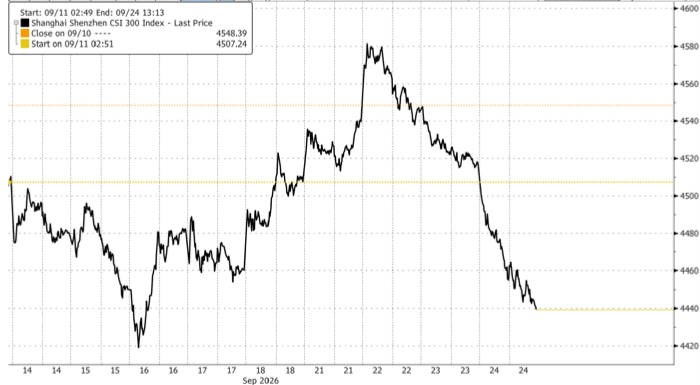
Image via ZeroHedge
China’s Trade-Truce Reality Check Hits Stocks Overnight
Chinese equities slid after what was billed as progress on the U.S.-China trade front landed more like a short-term patch than a durable deal. A two-month extension buys time, but it doesn’t buy confidence—especially when businesses need a twelve- to twenty-four-month runway to commit capital, hire, and rebuild supply chains.
For markets, the disappointment isn’t about one headline. It’s about the pattern: temporary truces, shifting enforcement, and policy risk that never fully clears. When investors sense the “pause” is just a reset before the next round of pressure, multiples compress fast—particularly in markets already wrestling with property overhang, uneven consumption, and capital flight sensitivity.
The net effect: China risk is back to being a trading instrument, not a compounding story. That’s fine if you’re nimble. It’s brutal if you came for stability.
🥃 Cole's Take: A two-month extension is a Band-Aid on a structural wound. If you want exposure here, treat it like a trade with tight risk controls, not a long-term marriage. The real signal to watch isn’t the truce length—it’s whether companies start committing capex again, because that’s when confidence turns into earnings.

Image via RealClearMarkets
Anthropic’s IPO Problem: It’s Not the Company—It’s the Moment
The argument making the rounds is simple: the world isn’t ready for an Anthropic public offering. Not because the tech isn’t real, but because the public-market framework for valuing frontier AI still looks like it was built for banks and soda companies—predictable margins, stable inputs, and clean lines between R&D and product.
Anthropic sits in the blast furnace of AI economics: massive compute bills, fast-moving competitive moats, regulatory uncertainty, and customer concentration risks that don’t show up nicely in a quarterly cadence. The average IPO buyer wants a story with a clear map to free cash flow. Frontier-model builders often have a different map: scale first, defend the platform, then negotiate power with infrastructure suppliers and enterprise customers.
That mismatch creates the real risk: a great company getting priced like a science project, then trading like a referendum on the entire AI complex every time a rival ships a new model or a regulator clears its throat.
🥃 Cole's Take: If Anthropic comes, expect volatility that makes dot-com look polite. I’d rather miss the first 20 percent than be trapped in the first 50 percent drawdown because the market can’t handicap compute economics. For most portfolios, the smarter play is to own the picks-and-shovels and profitable adopters, then revisit the model-builders once revenue durability shows up in boring places like renewals and margins.

Image via TheStreet
Diesel Export Ban Talk Is Another Shortcut to Higher Prices
The Energy Secretary is warning that banning diesel exports would push gasoline prices higher, even if the politics sounds tidy. The logic is inconvenient but straightforward: refining is an integrated system. You can’t easily force one output (diesel) to stay home without distorting the rest of the barrel—and refiners will respond by cutting runs, shifting yields, or exporting other products.
Policy that ignores the refinery math tends to backfire at the pump. If refiners see lower profitability or higher regulatory risk, they invest less, produce less, and the whole system gets tighter. In a tight market, “tight” becomes “expensive” quickly—especially when logistics and seasonal blends already add friction.
For investors and household budgets, this is the recurring theme: energy populism is still inflationary, just with a nicer slogan. The bill shows up later, in smaller print.
🥃 Cole's Take: If Washington starts messing with diesel flows, expect unintended consequences and higher volatility in crack spreads. I’m not forecasting doom—I’m forecasting math. In a portfolio, keep energy exposure practical: quality operators, disciplined balance sheets, and a willingness to take profits when politics starts driving the tape.

Image via Off Road Xtreme
GM’s 8.3L Duramax “Mongoose”: Big Torque, Bigger Questions
GM’s new 8.3L Duramax “Mongoose” for 2027 is the kind of headline that makes truck guys sit up straight. A massive diesel V8 in an era that keeps trying to convince you everything should be a silent appliance is a statement—about towing, longevity, and the simple joy of having more capability than you strictly need.
The early details paint a picture of a heavy-hitter aimed at serious work: big displacement, diesel torque expectations, and an apparent push to own the top end of capability wars. But as always with modern powertrains, the story won’t be just horsepower and torque. It’ll be emissions strategy, reliability under real-world duty cycles, serviceability, and what the package costs when it’s optioned the way owners actually buy it.
There’s also the broader market angle: if OEMs can still sell high-margin, high-capability trucks while electrification rolls forward, they will. Trucks fund a lot of the future.
🥃 Cole's Take: I love the idea of a diesel that’s unapologetically built for work, not a focus group. But I’m waiting to see the real-world reliability and the total cost of ownership—because the best engine on paper can turn into a wallet-drainer if the aftertreatment system is fragile. If you’re shopping, don’t pre-order the fantasy; let the first wave find the bugs.

Image via Car and Driver
The 1977 Thunderbird: When Comfort Was the Feature, Not the Apology
Car and Driver’s photo set of the 1977 Ford Thunderbird is a time capsule from the era when “personal luxury” meant long doors, plush interiors, and styling that prioritized presence over lap times. You can practically smell the velour and hear the slow-close thunk of a heavy door built before everything got optimized for weight and compliance targets.
It’s easy to dunk on cars like this from a modern performance lens, but that misses the point. The Thunderbird was about the experience: a rolling living room with a hood you could land a plane on. The interior details, trim choices, and proportions tell you what buyers valued—comfort, status, and the kind of calm you don’t get from a stiff suspension.
For collectors, cars like this aren’t just nostalgia. They’re reminders that “good life” used to be designed into the product, not added as an expensive package.
🥃 Cole's Take: The ’77 Thunderbird won’t make you money like a blue-chip muscle car, but it can make you happy in a way spreadsheets don’t capture. If you want one, buy the cleanest, most original example you can find and keep it maintained—not modified into something it never wanted to be. The real value here is cruising equity: relaxed miles, no urgency, all vibe.

Image via Robb Report
Oyster’s New 36M Superyacht: A Sailing Flagship for the Quiet Winners
Oyster has unveiled a new flagship sailing superyacht, the 36M—118 feet of long-range intent wrapped in a format that still respects seamanship. It’s positioned as an owner-customizable platform, which matters at this level because the buyers aren’t just purchasing a boat. They’re buying a mobile lifestyle: family time, remote anchorages, and the ability to disappear without asking permission.
The appeal of a sailing superyacht—done right—isn’t about skipping fuel bills. It’s about how you travel. Under sail, you’re not just relocating; you’re participating. And with Oyster’s reputation in bluewater circles, the promise is a blend of performance, safety, and the kind of livable design that can handle real miles, not just marina champagne.
In the luxury market, sailing is having a moment again because it reads as competence and taste. Loud money buys horsepower. Quiet money buys range, craftsmanship, and autonomy.
🥃 Cole's Take: If you’re going to spend at this altitude, at least buy something that can take you somewhere worth going. A sailing flagship like this is a better “asset” than most toys because it delivers experiences that don’t depreciate in your memory. Still, treat it like a business purchase: total operating costs, crew quality, and build schedule discipline matter more than the brochure promises.
Cole Hargrove | The Balanced Brief | Live Well. Invest Smart. No Apologies. If your week feels noisy, that’s the signal: tighten your process, trim the junk, and keep your dry powder for the moments the market hands you a gift.
— Cole Hargrove