The Fed held rates, CPI came in at 2.4%, and analysts still expect 12.5% Q1 earnings growth — but estimates have already been cut across nine sectors and the S&P 500 is stretched above its 5- and 10-year average forward P/E. Trading earnings on headlines alone in this environment is a costly mistake.
The free Earnings Season eBook breaks down the exact pre-report checklist, how to weigh guidance and expectations, and how to read the first reaction after numbers hit — so you're never improvising after the move already started.
Get the Free Earnings PlaybookBy clicking the link above, you will receive this free report and a free subscription to the StockEarnings daily email newsletter. You are also agreeing to the terms of our Privacy Policy. Unsubscribe at any time.

Live Well. Invest Smart. No Apologies.

Image via MarketWatch
Social Security “New Math” and the Dangerous Question Behind It
A fresh round of Social Security commentary is circling the same loaded question: what, exactly, are taxpayers entitled to? That framing sounds tidy, but it can quietly shift the debate from how we fund a program to whether the promise itself is optional, retroactive, or conditional on political mood. When you start treating benefits like a discretionary rebate instead of an earned social insurance commitment, you invite policy “solutions” that look clean on a spreadsheet and ugly in real households.
Here’s the part most people miss: Social Security isn’t just a retirement line item, it’s longevity insurance and disability insurance wrapped into one. The “new math” arguments often cherry-pick lifetime taxes paid versus expected benefits, and then call the difference a moral or fiscal failure. But the program was never built to be a perfectly individualized IRA with matching statements; it was built to stabilize the floor under the country, including survivors and people who can’t keep working.
None of this means the system can float forever on autopilot. Demographics and politics are real. But when the conversation drifts into “who deserves what” instead of “what mix of revenue and benefit adjustments keeps the promise intact,” you get the kind of policy drift that ends with sudden means-testing, stealth benefit cuts, or inflation indexing games that retirees only discover after the check stops keeping up.
🥃 Cole's Take: Social Security needs repairs, not a philosophical rewrite. If Washington wants credibility, start with transparent choices: a gradual payroll tax cap adjustment, a realistic retirement age discussion that accounts for hard physical work, and honest inflation indexing. The “entitlement” framing is a shortcut to breaking trust, and broken trust is expensive in markets and in real life.

Image via RealClearMarkets
Jackson Hole: Where the Inflation Story Gets Rewritten (Again)
Next week’s Jackson Hole gathering will do what it always does: turn a mountain backdrop into a message-testing lab for the Fed and everyone auditioning to steer it. The focus here is Kevin Warsh and the inflation playbook he’s likely to outline. When influential voices use that stage, it’s rarely academic; it’s a signal to markets about what “credible” policy looks like, and what pain they’re willing to tolerate to get there.
The subtext is simple: inflation may be cooler than the worst of the post-pandemic spike, but the public’s trust is still tender. If Warsh leans into a framework that prioritizes tighter policy discipline, clearer reaction functions, and less tolerance for “transitory” narratives, risk assets will hear it as higher-for-longer by another name. If he emphasizes growth sensitivity or financial stability, markets will read that as a softer landing bias.
Watch the language, not the applause. Jackson Hole is where policy people float the terms that later show up in actual votes and actual statements. A single phrase about wage dynamics, housing inflation, or fiscal dominance can change how investors price duration, credit spreads, and the next leg of the dollar.
🥃 Cole's Take: If you’re managing real wealth, the only Jackson Hole takeaway that matters is this: the inflation regime is now political, not just economic. I’d rather own quality balance sheets and real cash flows than bet on a dovish pivot that may never arrive. Keep some dry powder, keep duration intentional, and don’t let one speech bully you into chasing risk at the top of a narrative.
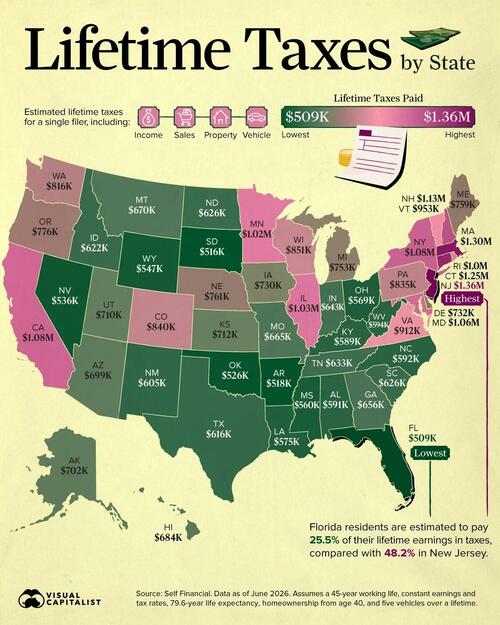
Image via ZeroHedge
New Jersey’s $1.36 Million Lifetime Tax Tab Is a Warning Label
A new visualization making the rounds pegs New Jersey as America’s highest lifetime-tax state at roughly $1.36 million. The exact figure will depend on assumptions, income path, and how you model property taxes, but the broader point is hard to argue: geography is one of the biggest line items in your lifetime wealth plan, and most people treat it like a lifestyle choice instead of a financial strategy.
High-tax states often counter with excellent schools, proximity to major job markets, and services that feel worth it when you’re in your peak earning years. Fair. But lifetime taxes aren’t just an annual annoyance; they compound against what you could have invested, what you could have saved for college, what you could have put into a second property, or what you could have spent buying time back. When property taxes and state income taxes stack, the drag can be permanent.
The bigger lesson isn’t “never live in New Jersey.” It’s to stop pretending state policy doesn’t touch your portfolio. Where you earn, where you own property, and where you retire are three separate decisions. Treat them separately and you’ll keep more of what you’ve already earned.
🥃 Cole's Take: I’ve sat in enough boardrooms to know people will negotiate a $50,000 bonus and ignore a six-figure tax drag over a decade. If you’re within 10–15 years of retirement, run the math now: income taxes, property taxes, and estate rules. You don’t need to flee overnight, but you do need a plan that doesn’t donate your compounding to a zip code.

Image via Backpacker
Remote Peaks Don’t Care About Your Ambition: A Missing Hiker Found Alive
A hiker attempting to summit the high point in every state went missing on one of the most remote: Wyoming’s highest mountain. After nearly a week, rescuers found him alive. It’s the kind of story that makes your stomach drop if you’ve ever watched weather roll over a ridgeline and realized the mountain has the final vote.
High-point goals are clean and motivating on paper, but remote alpine terrain punishes small mistakes: a navigation miss, an injury that slows you down, a storm that turns a straightforward route into a survival problem. The fact that he was found alive is a win for the hiker, for the rescue teams, and for every friend and family member who has stared at an unread text thread and tried not to imagine the worst.
There’s an investing analogy here that isn’t cute, it’s practical. In the backcountry, you build margin: extra food, extra warmth, a route plan, and a bailout option. In markets, margin looks like liquidity, position sizing, and humility about what you don’t control.
🥃 Cole's Take: I love big objectives, but I love coming home more. If you’re heading into remote country, carry the right comms, leave a real itinerary, and don’t let ego override a turnaround decision. The mountain doesn’t negotiate, and neither does risk when things go sideways.

Image via Car and Driver
The Camaro Comes Back with Four Doors and a V-8: Read the Room
Chevrolet’s Camaro is reportedly set to return as a sedan with an optional V-8 and rear-wheel-drive attitude. That’s a big statement in a world that keeps insisting the future is quiet, tall, and appliance-shaped. A muscle sedan revival isn’t just nostalgia; it’s GM reading demand for emotion, sound, and identity in a market saturated with sameness.
A four-door layout also says something practical: buyers still want performance, but they want it to fit real life. The old two-door muscle-car bargain with the devil was always packaging. If GM can deliver modern chassis tuning, livable interior space, and a V-8 option without pricing it into fantasy land, it could land with the exact guy who loves a backroad run and still has to pick up groceries.
From a business lens, this is about segmentation and margin. Performance trims, special packages, and enthusiast credibility can lift brand heat and profitability even as the broader lineup marches toward electrification. The trick is execution: weight, reliability, and price discipline.
🥃 Cole's Take: I’m not against EVs; I’m against boring. If Chevy actually ships a rear-drive V-8 sedan that looks right and drives right, there’s a real market for it among people who still enjoy the act of driving. Just don’t pay collector premiums on rumors—wait for specs, pricing, and whether it’s engineered with pride or built as a marketing prop.

Image via The Whiskey Wash
Whisky and Golf: Glen Moray Extends Its Senior Open Play
Glen Moray extended its partnership with the ISPS Handa Senior Open for another three years, doubling down on the intersection of Speyside single malt and the senior golf circuit. Sponsorship deals like this aren’t just logo placement; they’re targeted positioning. The senior audience tends to have time, taste, and discretionary income, which makes it one of the cleanest consumer profiles in the spirits world.
For the whisky category, golf remains a high-quality attention channel. It’s slow enough to talk, social enough to share, and ritual-heavy enough to turn a brand into a habit. When a distillery locks in an event partnership, it’s betting on long-term brand association: the dram after a round, the bottle as a gift, the pour at the clubhouse.
For consumers, it’s also a reminder that “premiumization” isn’t accidental. These brands are investing to stay in your line of sight so the next time you’re choosing between a familiar label and a new one, familiarity wins.
🥃 Cole's Take: This is smart marketing because it’s aligned marketing. If you’re the kind of guy who appreciates a well-struck iron and a decent Speyside, you’re exactly who they’re courting—and it works. My only rule: don’t let sponsorship tell you what’s good; let your palate decide, then buy the bottles you’d pour for a friend.
Cole Hargrove The Balanced Brief Live Well. Invest Smart. No Apologies.
— Cole Hargrove