Tax season quietly reshapes where capital flows — refunds hit accounts, portfolios get rebalanced, and positions get liquidated to cover obligations. That creates unusual early movement in small-cap stocks that has nothing to do with company fundamentals. Right now, certain names are already showing structural signals most investors will miss entirely.
We've put together a free Market Structure Guide breaking down how tax season shifts market activity, why some small-cap profiles move unexpectedly in March and April, and three companies already showing early breakout signals. The window to act before broader attention arrives is narrow — don't wait.
Get the Free Market Structure Guide*We encourage readers to perform their own research and due diligence on any information we provide. By clicking the link you will automatically be subscribed to the Fierce Investor Newsletter. Privacy Policy

Live Well. Invest Smart. No Apologies.

Image via Fox Business
Apple CEO Calls Price Hikes 'Unavoidable' as Memory Chip Costs Surge
Tim Cook just said the quiet part out loud: your next iPhone is going to cost more. The Apple CEO told investors that rising memory chip costs driven by AI demand have created what he's calling a "hundred-year flood" in the semiconductor supply chain. Translation: the race to build smarter AI into everything from smartphones to data centers has turned memory chips into the new oil, and even Apple — with its offshore cash hoard and supply chain dominance — can't negotiate its way out.
The culprit is high-bandwidth memory (HBM), the specialized chips that AI processing requires. Demand is outpacing supply by a wide enough margin that even the world's most valuable company is getting squeezed. Cook didn't give specifics on pricing or timelines, but "unavoidable" isn't the kind of word Apple uses lightly. Expect the iPhone 18 and whatever comes next in the fall lineup to carry a premium that makes last year's sticker shock look quaint.
🥃 Cole's Take: This isn't a blip — it's the cost of living in an AI-first world, and it's coming for every corner of tech. If you're holding Apple, you're fine long-term, but margin pressure is real and the easy money in AAPL is behind us. Watch the memory play instead: companies like Micron are printing money right now, and that's where the upside lives for the next 18 months.
Gas Drops Below $4, But Don't Get Too Comfortable
Gas prices have fallen below four dollars a gallon for the first time since the U.S. and Israel launched strikes on Iranian infrastructure in late February. Oil supply fears tied to the Strait of Hormuz have eased following a diplomatic framework that kept the waterway open and Iranian crude flowing under monitored conditions. It's a temporary win for drivers and a signal that cooler heads — or at least economic pragmatism — prevailed over escalation.
But don't confuse relief with a return to normal. Prices are still thirty percent higher than pre-strike levels, and the geopolitical risk premium hasn't vanished — it's just repriced. Any flare-up in the region, any breakdown in the Iran agreement, and you're back over five dollars before the weekend. Energy markets have a short memory and a long fuse.
🥃 Cole's Take: If you've been waiting to top off the truck or plan that road trip, now's your window. But this isn't 2019, and it's not coming back. I'm keeping a small position in energy equities because the structural underinvestment in oil infrastructure hasn't changed, and the next supply shock is always one headline away.
📎 CNBC
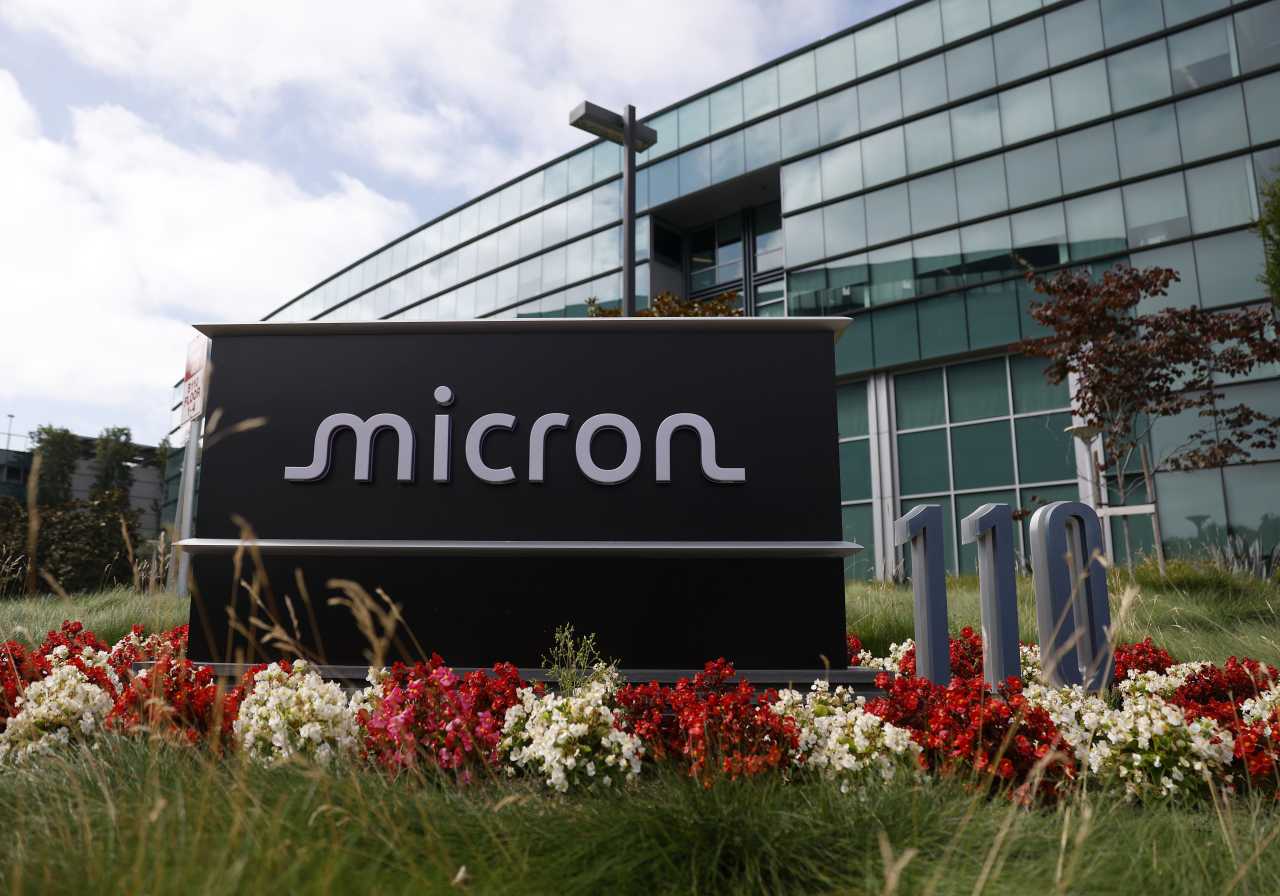
Image via MarketWatch
Micron's Rally Has Legs — and Apple's Pain Is Their Gain
Micron's stock is climbing as analysts confirm what the chip shortage already told us: memory demand is going to outrun supply for the foreseeable future. Even with new fab capacity coming online in the U.S. and Asia, production can't catch up to the appetite created by AI training, edge computing, and data center build-outs. The same pricing pressure squeezing Apple is lighting a fire under Micron's revenue growth and margin expansion.
This is a textbook supply-demand imbalance with a long runway. Memory chips aren't something you can just spin up in a garage — they require billions in capital, years of lead time, and flawless execution. Micron, Samsung, and SK Hynix control the market, and right now they're in the driver's seat. For investors, that means pricing power and a rare chance to ride a durable tailwind in an otherwise choppy semiconductor landscape.
🥃 Cole's Take: I've been adding to my Micron position since March, and I'm not done. This is one of the clearest setups I've seen in years — inelastic demand, constrained supply, and management that's finally learned to be disciplined. If you missed Nvidia's run, this is your second bite at the AI infrastructure apple.

Image via Car and Driver
Land Rover's New Defender Is Getting Built in Detroit (Sort Of)
Jaguar Land Rover just announced a partnership with Stellantis to produce a U.S.-market Defender using Stellantis platforms and manufacturing. It's a strategic pivot away from China, where JLR has faced weakening demand and increased competition from domestic EV brands. The move lets Land Rover keep its premium brand positioning while tapping into Stellantis's North American production scale and parts bin — a pragmatic play that acknowledges the realities of tariffs, supply chains, and shifting consumer markets.
Details are thin, but expect the new Defender to share underpinnings with vehicles like the Jeep Wrangler or Grand Cherokee, albeit with British styling and luxury touches. It's a compromise, but one that makes sense if you're trying to keep costs reasonable and U.S. buyers happy. The bigger story here is the continued retreat of legacy European automakers from China, a market that was supposed to be the golden goose and has turned into a tariff-laden, policy-whipped headache.
🥃 Cole's Take: I'm not thrilled about a Stellantis-based Defender, but I get it — and if it keeps the price under ninety grand and the truck on dealer lots, it's probably the right call. This is what deglobalization looks like in real time: supply chains reshore, partnerships get weird, and the product you get isn't quite what it used to be. But it'll still look great parked at the trailhead.

Image via Surfer
Southern California's 'Swell of the Decade' Delivers in Photos
Southern California just got hammered by what surfers are calling the best early-summer swell in a decade. From Malibu to The Wedge, the coast lit up with overhead-plus waves, clean conditions, and the kind of energy that only comes when a deep low-pressure system lines up perfectly with bathymetry and wind. Photographer Ryan "Chachi" Craig captured the chaos — massive barrels, launches off The Wedge's infamous shore break, and enough froth to remind you why people tolerate LA traffic and eight-dollar lattes.
For those of us who chase outdoor experiences as hard as we chase returns, this is the kind of story that matters. It's not just surf porn — it's a reminder that the best moments in life are the ones you can't schedule, can't buy, and definitely can't replicate on a Peloton. You just have to be ready when the swell shows up.
🥃 Cole's Take: I'm not a surfer, but I respect the hell out of anyone who drops everything when the conditions align. Life's too short to wait for perfect timing — in the ocean or the market. If you've been putting off that trip or that adventure because the calendar doesn't line up, this is your nudge to stop waiting.
📎 Surfer

Image via Robb Report
Rudolph Valentino's Rumored Love Nest Hits the Market at $2.3 Million
A Spanish Revival cottage in LA's historic Whitley Heights just listed for $2.3 million, and it comes with a story: Rudolph Valentino allegedly built it in the 1920s for silent film star Pola Negri. Whether the legend holds up to scrutiny is debatable, but the house itself is a gem — meticulously restored with Scandinavian and Japanese design influences that somehow work alongside the original Spanish bones. Arched doorways, tile work, canyon views, and the kind of old Hollywood charm you can't fake.
At $2.3 million it's priced for someone who values character over square footage and wants a piece of LA history that doesn't feel like a museum. It's also a reminder that real estate — especially in supply-constrained, story-rich neighborhoods — tends to hold value better than the flavor-of-the-month condo towers going up in every mid-tier market.
🥃 Cole's Take: I'd take a cottage with a story over a glass box with a rooftop pool any day. Real estate like this appreciates because it's irreplaceable, and the buyer who understands that is the one who'll look smart in ten years. If you're shopping in LA and have the budget, this is the kind of property worth stretching for.
Stay sharp, stay solvent, and don't wait for perfect conditions. — Cole
— Cole Hargrove