Sponsored By:
America's national debt has blown past $40 trillion — and we're adding another trillion every five months. Interest payments alone now top $1 trillion a year, meaning borrowed money is paying interest on borrowed money. Economists call this a debt death spiral, and your retirement savings could be caught in the middle.
A new free report reveals the three ways governments escape a debt spiral, how purchasing power quietly erodes, and exactly how to move a portion of your savings into a financial safe haven before it's too late. No cost. No obligation. Delivered to your inbox in minutes.
Get the Free Debt Death Spiral ReportThis is an advertisement from American Alternative Assets. If you no longer wish to receive these promotions, unsubscribe here. American Alternative Assets | 21700 W Oxnard St, Suite 850, Woodland Hills, CA 91367.

Live Well. Invest Smart. No Apologies.

Image via Fox Business
Anthropic Steps Into the SEC Spotlight—and the AI IPO Clock Starts Ticking
Anthropic has filed SEC paperwork ahead of what’s shaping up to be one of the most watched tech debuts in years. Translation: the company is moving from private-market mythology into a world where numbers have to reconcile, customer concentration gets named, and "adjusted" stops being a free pass.
The bigger point is capital intensity. Frontier AI isn’t an app business; it’s a power-and-chips business. If Anthropic is heading to Nasdaq to fund the buildout, expect the prospectus to read less like Silicon Valley storytime and more like industrial economics—compute commitments, infrastructure spend, and the ongoing race to lock in supply.
This filing also matters for the whole IPO pipeline. If the market gives a premium multiple to an AI name with real enterprise traction, it pulls other candidates forward. If it stumbles, the window narrows fast and everyone goes back to private rounds with harsher terms.
🥃 Cole's Take: I’ll read this one like a credit analyst, not a fanboy: cash burn, contracted compute costs, and how sticky the revenue really is. The AI trade has been crowded, but an IPO forces discipline—good for investors if they don’t overpay for "potential" that requires endless capex. If the valuation comes in sane, it’s worth watching closely; if it’s priced like 2021 never ended, let someone else buy the first day pop.
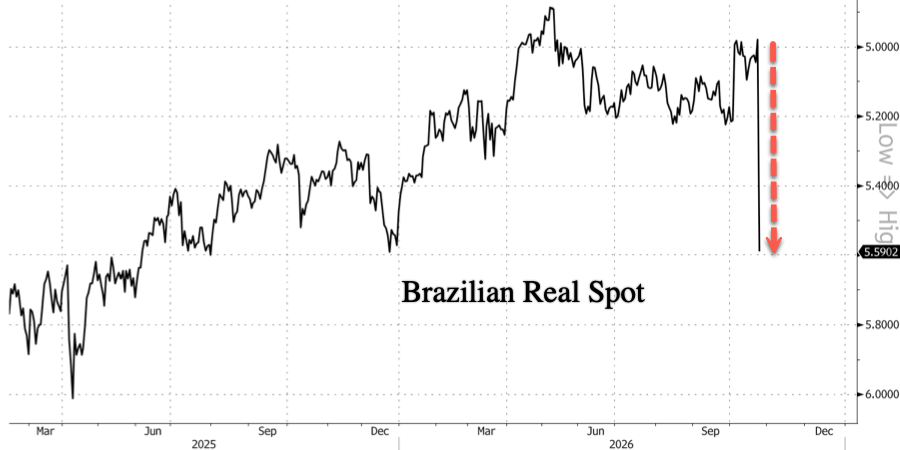
Image via Zero Hedge
Brazil Reminds Everyone: Politics Can Still Punch a Hole in Your Portfolio
Markets in Brazil took a hard hit after an election shock triggered a fast unwind of the so-called "Bolsonaro trade." Stocks cratered, the real slid, and volatility surged as investors tried to reprice policy risk in real time.
This is what political risk looks like when it’s not theoretical. Capital hates uncertainty, and Brazil is one of those countries where the gap between campaign rhetoric and governing reality can be wide enough to drive a truck through. When investors fear heavier intervention, fiscal slippage, or pressure on institutions, they demand a bigger risk premium—immediately.
For U.S.-based investors, this kind of move tends to show up through EM ETFs, commodity knock-ons, and currency translation hits in multinationals. It’s also a reminder that election outcomes can detonate positioning even when the underlying businesses didn’t change overnight.
🥃 Cole's Take: If you want to own Brazil, fine—but treat it like a position that needs a seatbelt, not a retirement plan. I don’t chase panic candles, but I also don’t average down blindly when policy direction is unclear and the currency is in freefall. Let the dust settle, watch the central bank posture, and only then decide whether you’re investing or gambling.

Image via Forbes
Meta’s Muse Hits 10 Million Users—and Retail Giants Pick Sides
Meta’s Muse has reached 10 million users, and the interesting part isn’t the user count—it’s who wants to plug into it. Walmart reportedly sees AI agents as a sales lever, a way to guide shoppers, automate decisions, and make the path from intent to checkout frictionless.
Amazon, on the other hand, has reason to be wary. If AI agents become the interface layer between consumers and products, whoever controls the agent controls the customer relationship. That’s existential for a platform built on owning discovery, checkout, and the data flywheel.
We’re watching the next battleground in commerce: not just ads or delivery speed, but the digital “butler” that makes purchasing decisions with you—or for you. Whoever wins that interface could skim margin from everyone downstream.
🥃 Cole's Take: The future of retail isn’t another storefront; it’s the concierge. Walmart’s move tells me it’s willing to rent an interface if it boosts volume, while Amazon would rather own the interface even if it slows adoption. As an investor, I’m less interested in who has the flashiest agent and more interested in who captures the data and gets paid at the moment of purchase.
📎 Forbes

Image via Off Road Xtreme
Ford’s Bronco ORV Package Is a Reminder: Grown Men Still Buy Toys—And That’s a Business Model
Ford Custom Garage is leaning into a simple truth: Broncos are bought to be used, modified, and personalized. The Bronco ORV Package layers in the kind of gear that actually matters off pavement—FOX suspension, Raptor skid plates, RIGID lighting, and WELD wheels—aimed squarely at owners who want capability without piecing it together one part at a time.
This isn’t just about off-road cred. It’s margin. OEM-backed accessories and upgrade packages keep dollars inside the brand ecosystem and turn a one-time vehicle sale into a longer relationship. In a world where unit growth is harder and incentives come and go, accessories are a quieter profit engine.
There’s also a brand halo effect: build a legitimate off-road platform and you sell lifestyle, not just sheet metal. That lifestyle sells apparel, gear, financing, and repeat customers—especially when the community aspect is strong.
🥃 Cole's Take: I like seeing automakers monetize passion without making owners feel gouged. If Ford can deliver factory-grade upgrades that actually perform, it protects resale values and keeps buyers loyal. Just remember: the best “package” is still driver skill and a little humility—because gravity doesn’t care what wheels you bought.
Boat Handling Is the Unsexy Edge That Puts More Fish in the Box
Good angling isn’t only about lures and luck; it’s about boat control. The core idea is positioning—using wind, current, and throttle discipline to hold over structure, manage drift, and keep your lines where the fish actually are.
The small stuff adds up: how you approach a spot without spooking fish, how you set a drift line that repeats, and how you keep the crew coordinated so you’re not tangling lines while the bite window closes. It’s part seamanship, part choreography.
If you’re investing in electronics, trolling motors, and nicer gear, boat handling is the skill that makes those purchases pay you back. A well-run boat turns time on the water into time on target.
🥃 Cole's Take: This is like risk management in markets: the boring discipline is what keeps you in the game long enough to win. Learn to read wind and current the way you read a chart—context first, action second. The guys who consistently catch fish aren’t always the ones with the most gear; they’re the ones who can put the boat exactly where it needs to be, again and again.

Image via Car and Driver
Audi Drops $4 Billion on Georgia—A Serious U.S. Manufacturing Bet
Audi plans to invest $4 billion into its first U.S. factory, slated for Georgia, to build SUVs designed for the American market. The likely lineup includes larger vehicles like the Q7, Q8, and a potential Q9—exactly where U.S. demand and profit pools tend to be.
This isn’t just a ribbon-cutting story; it’s a supply-chain and policy story. Building in the U.S. helps manage currency swings, shipping costs, and tariff risk, and it can improve eligibility for various incentive regimes depending on sourcing and battery supply chains across the broader industry.
For the region, it’s a jobs-and-suppliers magnet. For the auto sector, it’s another signal that the post-pandemic world favors redundancy and proximity over pure lowest-cost optimization—especially for high-margin models.
🥃 Cole's Take: When an automaker writes a $4B check, they’re telling you they expect demand to stick and policy to reward local production. I like this move because it reduces logistical fragility and puts Audi closer to the customer who actually buys the big SUVs. If you’re tracking industrial spillovers, watch the supplier ecosystem that follows—those second-order winners can be where the real returns hide.
Cole Hargrove | The Balanced Brief — Live Well. Invest Smart. No Apologies.
— Cole Hargrove