History shows a clear pattern: the investors who recognized the exact inflection point in the dot-com boom pocketed 400–800% gains in 18 months. Those who spotted the same moment in cloud computing saw 300–600% returns. Based on 50 years of market data, that same moment is happening right now — and the acceleration phase has already begun.
This free 7-page report reveals where we are in the current megatrend cycle, why the next 18 months are critical, and how to position yourself before the window closes. Don't be the investor who enters too late.
Get the Free ReportBy clicking 'Get the Free Report' you are automatically subscribing to Darwin Investor Network and will receive a free subscription to the Chaikin PowerFeed newsletter. Unsubscribing is easy. Privacy Policy

Live Well. Invest Smart. No Apologies.

Image via Yahoo Finance
Markets Rally Because the Economy Isn't Too Hot — Welcome to 2026
The Dow, S&P 500, and Nasdaq all pushed higher Thursday after June's jobs report came in softer than expected. Nonfarm payrolls missed consensus, wage growth cooled, and suddenly Wall Street's pricing in rate cuts like they're on clearance. It's the same playbook we've seen for eighteen months now: bad news for Main Street becomes good news for your portfolio because the Fed gets room to ease.
Traders are now betting the central bank will cut at least twice before year-end, maybe three times if inflation keeps behaving. Tech led the rally — no surprise there — while financials lagged on the assumption that lower rates mean thinner margins. The VIX dropped back under 13, and bond yields fell across the curve. It's a Goldilocks setup if you ignore the fact that actual job creation is running cold.
The psychology here is fascinating. We've trained an entire generation of investors to root against economic strength because monetary policy is the only game that matters. Corporate earnings are solid, balance sheets are clean, but none of that moves the needle like a weak payroll print that gets Powell back in easing mode.
🥃 Cole's Take: I've made money in stranger environments, but this one still feels backward. If you're long equities — and you should be — this rally makes sense. Just don't confuse a trading opportunity with a healthy economy. Stay positioned in quality tech and dividend aristocrats, and keep some dry powder for when this narrative flips.
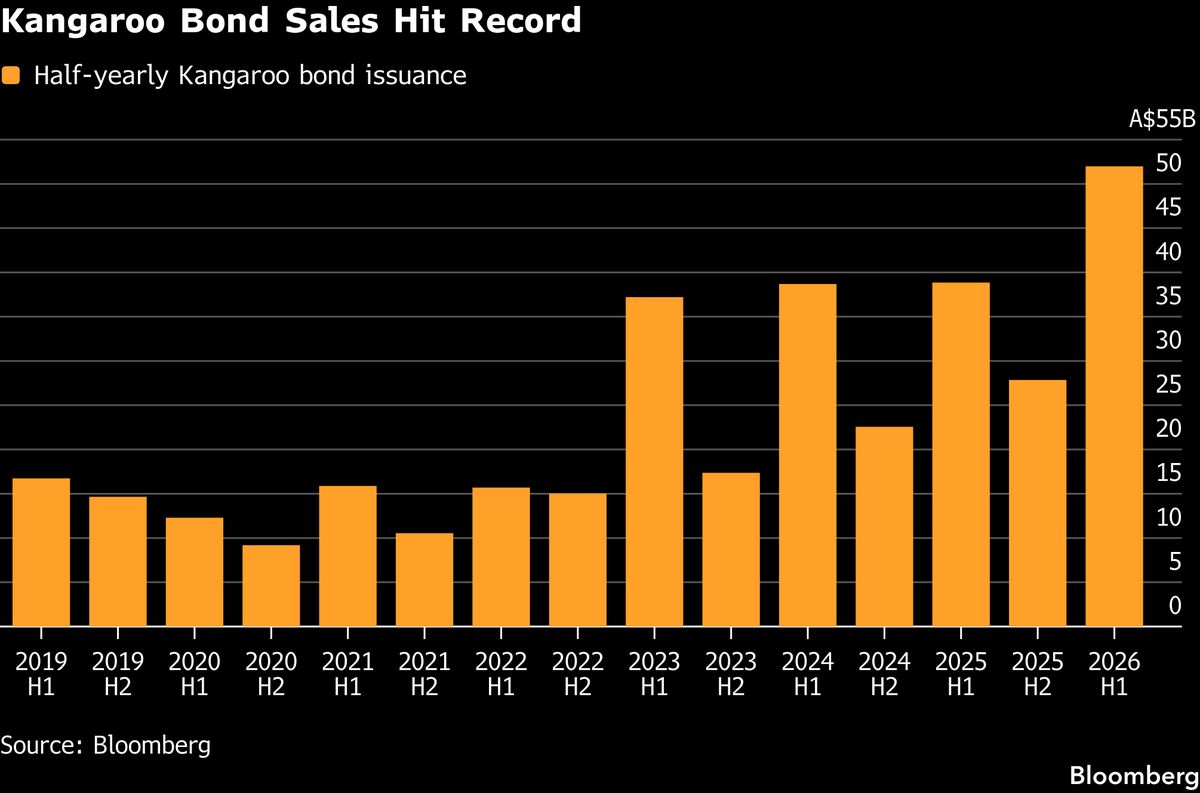
Image via Bloomberg
Kangaroo Bonds Hit $36 Billion as Smart Money Floods Australia
Global treasurers are piling into Australia's bond market at a record pace, with Kangaroo bond issuance hitting $36 billion and climbing. The appeal is straightforward: Asian capital is flooding the market, keeping borrowing costs competitive even as other developed markets tighten. Australia's AAA rating, deep liquidity, and relative yield advantage are pulling corporate and sovereign issuers away from traditional euro and dollar markets.
The surge is being driven largely by Japanese, Chinese, and Korean institutions looking for diversification outside their home currencies and better risk-adjusted returns than what Europe or the U.S. can offer right now. Australian banks are happy to facilitate, and the Aussie dollar's relative stability compared to the yen and yuan makes hedging cheaper. It's a technical trade with macro tailwinds, and it's working.
This isn't just about yield chasing. It's a signal that capital is quietly rotating toward jurisdictions with fiscal discipline, commodity backing, and distance from the geopolitical mess brewing in Europe and the South China Sea. Australia checks those boxes.
🥃 Cole's Take: If you're not paying attention to Australia as a wealth-preservation jurisdiction, you're missing the plot. The bond market is a leading indicator. Consider Aussie exposure in your fixed income allocation — either directly or through currency-hedged funds. This trend has years left to run.
Homeowners With Sub-3% Mortgages Just Stopped Paying Them Off
One of the stranger distortions in this economy just got stranger. For months, homeowners with those golden sub-3% mortgages from 2020 and 2021 had been steadily paying them down despite the lock-in effect keeping them from selling. It was slow, but it was happening — refis into shorter terms, extra principal payments, the usual amortization grind. Then it stopped. Dead in the water.
The data from Wolf Street shows that payoff activity on mortgages under 3% has stalled out entirely. Homeowners who were accelerating payments have shifted gears. Why? Because they've done the math. With inflation running 3% to 4% and mortgage rates at 2.75%, they're effectively being paid to borrow. Every dollar tied up in home equity is a dollar not working in a portfolio that's been ripping for two years. The rational move is to let that cheap debt ride forever and deploy capital elsewhere.
This has massive implications for housing inventory, which was already choked. If people aren't paying off mortgages, they're not moving. If they're not moving, supply stays locked. And if supply stays locked, prices stay elevated no matter what the Fed does with short-term rates. It's a feedback loop with no obvious exit.
🥃 Cole's Take: I've got a 2.875% mortgage I'll never pay off, and neither should you if you're sitting on one. That's free money in real terms. Let it amortize on schedule and put your excess cash into assets that actually compound. Housing will stay tight until something breaks — bet accordingly.

Image via Backpacker
The Allegheny Mountains Are Calling — And You Should Answer
If you're looking to disappear into real wilderness without flying across the country, Pocahontas County in West Virginia's Allegheny range should be at the top of your list. Backpacker just published a roundup of eight must-visit hiking areas in the region, and every single one delivers the kind of solitude and terrain that's getting harder to find east of the Rockies. Deep forests, rolling ridgelines, and trails that see a fraction of the traffic you'd fight through in the Smokies or Shenandoah.
The Allegheny high country sits at elevation, which means cooler temps in summer and legitimate alpine-style hiking without the altitude sickness. Cranberry Wilderness, Dolly Sods, and the Monongahela National Forest offer everything from easy day hikes to multi-day backcountry loops. The trout fishing is exceptional if you bring a rod, and the fall colors rival anything in New England without the crowds.
This is the kind of destination that reminds you why you work hard — not for another watch or car, but for the freedom to pack a bag on a Wednesday and be on a ridgeline by sunset. West Virginia doesn't get the credit it deserves, but the people who know, know.
🥃 Cole's Take: I've been talking about a fall trip to the Alleghenies for two years, and this might be the year I pull the trigger. If you're tired of fighting for campsites in Yellowstone or paying $400 a night in Jackson Hole, head east. It's cheaper, closer, and just as good.

Image via Outdoor Life
The Guns That Built America (But Never Made the Cover)
Outdoor Life just published a list of the greatest guns in American history that never became household names, and it's a reminder that the best tools don't always get the loudest press. These aren't the Colt Single Actions or Winchester 1873s you see in every Western. These are the workhorses — the Marlin 336, the Savage 99, the Browning Auto-5 — that put meat on tables, won wars in the margins, and defined generations of shooters who didn't care about brand clout.
The Marlin 336, for example, has been in continuous production since 1948 and is still the best lever-gun value on the market. The Savage 99 pioneered rotary magazines and smokeless powder in a lever action when everyone else was still stuck in the 1880s. And the Browning Auto-5, designed by John Browning himself, was the first successful semi-auto shotgun and stayed in production for nearly a century. These are guns that worked, lasted, and didn't need a marketing department.
In a world obsessed with the latest tactical gear and influencer endorsements, there's something grounding about recognizing the designs that actually mattered. Function over flash. Longevity over hype.
🥃 Cole's Take: If you're building a gun collection — or just want one reliable rifle and shotgun — start with the stuff that's been proving itself for 75 years. I'll take a used Marlin 336 over half the overpriced ARs on the market. Boring works.

Image via Car and Driver
The $1.3 Million Hypercar With a Fan That Sucks It to the Road
McMurtry just released the Spéirling Pure, the production version of the fan car that's been obliterating track records for the past two years. It generates 4,400 pounds of downforce instantly — not through aerodynamics, but through a massive fan that literally sucks the car to the pavement. It's the same tech that got banned in Formula 1 in the 1970s because it was too fast. Now you can buy one for $1.3 million, assuming you're on the list.
The specs are absurd: 0-60 in under 1.5 seconds, sub-8-second quarter mile, and lap times that embarrass cars costing twice as much. It's electric, single-seat, and built in extremely limited numbers. This isn't a car you daily drive or even track casually. It's a piece of engineering theater for people who've run out of things to buy and want something genuinely unhinged.
McMurtry is targeting the same clientele that bought the original Bugatti Bolide or the Mercedes-AMG One — wealthy collectors who want bragging rights and a machine that can't be replicated. The fan tech is the hook, but the exclusivity is the real product.
🥃 Cole's Take: I respect the engineering, but I'll never understand spending this kind of money on a car you can't legally drive on a real road and will never push to its limits. That said, if you bought Bitcoin at $200, maybe this is exactly the toy you deserve. I'll stick with my 911 and a reliable smoker.
Enjoy the long weekend. Markets are closed Friday. I'll be on a trail somewhere, thinking about nothing but the next ridgeline. — Cole
— Cole Hargrove