Tax season creates hidden market shifts that can mislead investors. Refunds hit accounts, portfolios get rebalanced, and positions move to cover obligations — creating liquidity changes that make small-cap moves appear more meaningful than they actually are.
Our 2026 Market Flow Briefing reveals how tax-season liquidity affects market action, why current moves seem disconnected from fundamentals, and exposes one profitable setup emerging under these exact conditions.
Get the Free Briefing*We encourage readers to perform their own research and due diligence on any information we provide. By clicking the link you will automatically be subscribed to the Stock Wire News Newsletter.

Live Well. Invest Smart. No Apologies.

Image via Bloomberg
The Private-Jet Economy Is Doing Just Fine, Thanks
Commercial airlines are trimming routes and travelers are blinking at higher prices—but the private jet market is still humming. Bloomberg notes flight activity and new jet orders are climbing even as fuel costs rise on renewed Iran-war risk. That’s not “luxury spending”; that’s a signal that the top end of the income and balance-sheet ladder hasn’t felt much pain.
A lot of this is structural now: fractional ownership, jet cards, and better scheduling tech have made private aviation more “subscription” than splurge. And corporations that learned to value time (and control) during the last few years aren’t eager to go back to missed connections and delayed itineraries when deals are on the line.
🥃 Cole's Take: If you’re looking for recession tells, private jets aren’t flashing them. This is a classic “K-shaped” reminder: parts of the consumer economy are tightening, while the asset-rich keep moving—and paying. Investors should read this as support for high-end services, aviation OEM backlogs, and “time-saver” business models, not as proof the broader economy is fine.
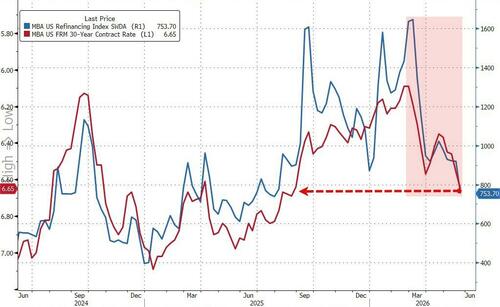
Image via ZeroHedge
Refi Activity Falls Off a Cliff as Rates Push Higher
Refinancing volume just dropped hard as mortgage rates hit 9‑month highs, according to ZeroHedge. That’s not exactly a shock: most homeowners who could refinance already did when money was cheap, and today’s rates don’t offer relief—just higher payments.
The bigger issue is what this does to household cashflow and mobility. When refis dry up, people lose a key lever to tap home equity cheaply. And when buyers can’t stomach payments, sellers with low-rate mortgages tend to sit tight, keeping inventory constrained and the whole market sluggish.
🥃 Cole's Take: This is the “golden handcuffs” housing market getting tighter. Don’t expect a clean crash if supply stays locked—but do expect less consumer liquidity and more regional stress where insurance, taxes, and job growth are ugly. If you’re house shopping, negotiate like a shark; if you’re holding, protect your cash buffer and don’t bank on easy equity extraction.
Micron and the “WTF” AI Mania Chart
Wolf Street put Micron on the operating table and the chart looks like a familiar story: big spike, big narrative, then historically… a brutal collapse. MU has a track record of getting cut in half (or worse) after hype peaks, routinely trading below its old dot‑com high—an impressive feat of cyclicality and investor amnesia.
The difference this time, bulls argue, is AI demand: data centers, memory bandwidth, and the whole picks-and-shovels angle. And yes—AI is real. But semiconductors are still a knife fight between capacity expansions, pricing power that comes and goes, and the market’s tendency to overbuild right when optimism feels “obvious.”
🥃 Cole's Take: I don’t short great businesses—but I also don’t marry cyclical momentum charts dressed up as destiny. If you own MU, treat it like a trade with risk controls, not a forever-hold story you tell yourself on red days. AI demand can be durable *and* the stock can still get smoked when the cycle turns—both can be true.

Image via GOLF.com
Five Simple Pitch-Shot Fixes That Actually Work Under Pressure
GOLF.com ran a tight set of tips from Top 100 Teacher Kellie Stenzel on improving pitch shots—those in-between swings that separate a good round from a “why do I do this” walk back to the cart. The core theme: simplify your setup and motion so you can repeat it when the lie is sketchy and your buddies are watching.
Her guidance focuses on practical levers: controlling low point, using the right club/trajectory for the situation, and keeping technique from getting too “handsy.” Pitching is scoring—not style points—so the goal is predictable contact and distance, not a highlight reel.
🥃 Cole's Take: Pitch shots are portfolio management in golf form: small mistakes compound fast. Pick one setup you can repeat, own your landing spot, and stop trying to manufacture spin like you’re on Tour. Boring pitches make for exciting scorecards.
📎 GOLF.com

Image via Car and Driver
The “Not-So-Great Eight”: Why Controversial Cars Keep Happening
Car and Driver rounded up the most controversial cars of the 2000s (so far), using the Ferrari “Luce” as the latest example of what happens when brand ambition meets public opinion’s buzz saw. The pattern is consistent: automakers chase a new segment, a new design language, or a new powertrain identity—and they misjudge what enthusiasts will tolerate.
Some of these cars age into cult classics; others stay punching bags forever. But the business logic isn’t always dumb—companies are trying to future-proof margins, regulations, and consumer shifts. The problem is that “future-proof” can look like “soulless” when it lands wrong.
🥃 Cole's Take: Controversial cars are a reminder that brand equity is an asset—and you can light it on fire quickly. For investors, watch the brands that can pivot without alienating their base; for buyers, let the first wave take the depreciation hit. The best time to buy “controversial” is usually three years later, not day one.

Image via Robb Report
Buffalo Trace Revives Two Heavy-Hitter E.H. Taylor Bottles
Robb Report says Buffalo Trace is bringing back two of its most collectible Colonel E.H. Taylor, Jr. bourbons—Four Grain and Cured Oak—in limited numbers. These are the kinds of releases that don’t really “launch”; they detonate. Demand will overwhelm supply, secondary prices will get loud, and most people will never see one on a shelf at MSRP.
This is also the modern bourbon reality: top producers manage hype, scarcity, and allocation like a luxury goods house. The whiskey may be excellent—but the market dynamics are doing plenty of the work, especially when collectors treat bottles like tradable assets.
🥃 Cole's Take: If you can buy at retail and you love the juice, great—open it and enjoy it with people who matter. If you’re buying at secondary like it’s a pension plan, be careful: collectibles are liquid until they aren’t, and hype cycles can turn. The best bourbon “investment” is still a bottle you’d be happy to drink.
I’m Cole Hargrove—protect the downside, press the edge, and save a little daylight for the back nine.
— Cole Hargrove