Sponsored By:
America's national debt has blown past $40 trillion — and we're adding another trillion every five months. Interest payments alone now top $1 trillion a year, meaning borrowed money is paying interest on borrowed money. Economists call this a debt death spiral, and your retirement savings could be caught in the middle.
A new free report reveals the three ways governments escape a debt spiral, how purchasing power quietly erodes, and exactly how to move a portion of your savings into a financial safe haven before it's too late. No cost. No obligation. Delivered to your inbox in minutes.
Get the Free Debt Death Spiral ReportThis is an advertisement from American Alternative Assets. If you no longer wish to receive these promotions, unsubscribe here. American Alternative Assets | 21700 W Oxnard St, Suite 850, Woodland Hills, CA 91367.

Live Well. Invest Smart. No Apologies.

Image via Fox Business
Trump Media Buys a National Moment in Rome
Trump Media ran its first national television ad during a college basketball game played in Rome, with interim CEO Kevin McGurn framing it as a milestone moment for the company. It’s a classic move: take a live sports audience, add the novelty of an overseas venue, and try to convert attention into brand legitimacy.
For investors, the bigger point isn’t the ad creative or the game location. It’s the company signaling it wants to play at national scale, which means bigger marketing checks, a sharper focus on customer acquisition, and likely a louder push to prove it can monetize beyond the core audience that already knows the brand. That’s a spend-now, justify-later strategy, and markets tend to demand receipts sooner than management teams prefer.
🥃 Cole's Take: National ads are a flex, not a business model. If you’re looking at this as an investment theme, watch unit economics and repeat engagement, not splashy placements. A company can buy attention in one night; it has to earn durable revenue quarter after quarter.

Image via TheStreet
iPhone Margins Meet a $190 Reality Check
A key iPhone component most people never think about just got meaningfully more expensive: memory. TheStreet points to a roughly $190 cost problem, and if that number is even directionally right, Apple faces the same choice every consumer brand faces when inputs jump: eat it, pass it on, or redesign around it.
Apple’s superpower has always been pricing power and supply-chain discipline, but “discipline” doesn’t mean “immune.” Higher memory costs can squeeze margins on certain models, push prices higher at retail, or encourage Apple to adjust configurations in ways that keep the sticker price stable but protect profitability. None of those options are painless, especially when consumers are already trained to hold onto phones longer.
🥃 Cole's Take: Apple can usually pass costs along, but there’s a limit to how many times you can ask customers to pay more for what feels like incremental upgrades. If memory costs stay elevated, I’d expect Apple to protect margin first and let volumes be the pressure valve. For investors, that means watch gross margin commentary and mix, not just unit headlines.
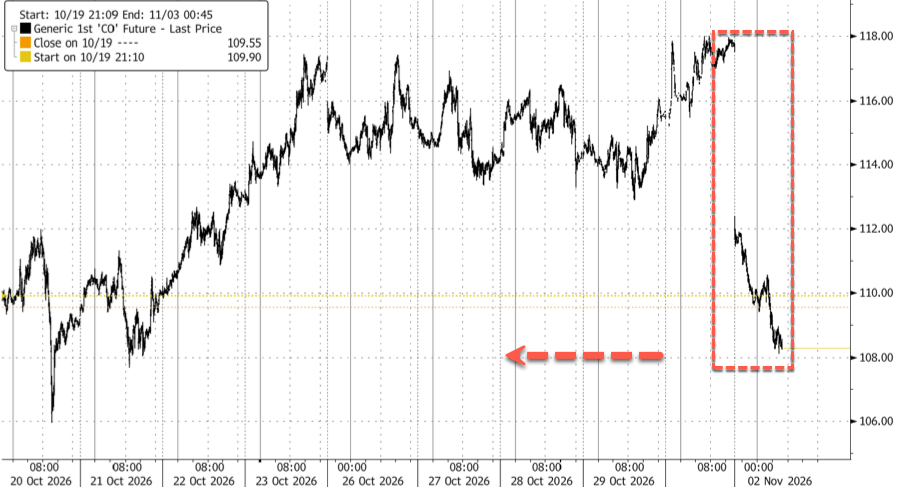
Image via ZeroHedge
Oil Sells Off on a Two-Day Promise and a Diplomacy Head Fake
Crude futures fell as markets reacted to signals that Trump may give diplomacy a chance while Iran floated a two-day reopening of the Strait of Hormuz. Brent slipped to around $108 a barrel and WTI moved lower as traders priced in even a temporary easing of the choke point risk.
This is how energy markets behave when geopolitics drives the tape: they trade probabilities, not certainties. A two-day reopening is not a solution, it’s a headline. But in a highly levered futures market, headlines are enough to trigger positioning unwinds, stop-loss cascades, and a quick reset in risk premium—until the next headline reverses it.
🥃 Cole's Take: If your plan is built on “the Strait will stay open” or “it will close for months,” you don’t have a plan—you have a prayer. Treat this as volatility, not a new equilibrium. I’d rather own quality energy cash-flow generators and use pullbacks to add than try to day-trade diplomacy out of a chokepoint.

Image via Off Road Xtreme
A 549-HP Bronco That Exists for One Purpose: Get You to the End of the Trail
Off Road Xtreme profiled a custom “Evil Twin” 1976 Ford Bronco built around a 549-hp 427 stroker V8, long-travel suspension, and 40-inch tires. This isn’t a nostalgic restoration; it’s a modern off-road weapon wearing classic sheetmetal.
There’s a quiet trend here that goes beyond one truck: high-end custom builds are becoming a legitimate luxury category, sitting somewhere between collector car culture and outdoor gear obsession. People want capability, presence, and a story they can drive. And unlike a lot of “luxury,” you can actually use this one hard without apologizing for it.
🥃 Cole's Take: This is the kind of purchase that makes sense only after your balance sheet does. But if you’re already there, I’d rather see money parked in a well-built, usable rig than another forgettable status toy that depreciates in a valet line. Just remember: horsepower is cheap; reliable fabrication and clean execution are what hold value.

Image via Car and Driver
The Shelby Badge That Slipped Past Your Memory Is Back on the Block
Car and Driver flagged an unusual one: a 1987 Shelby Lancer listed for sale on Bring a Trailer. It’s not a Mustang, and that’s the point. It’s a reminder that the Shelby name touched more corners of automotive history than most people recall.
Cars like this sit in a strange sweet spot for collectors: niche enough to be overlooked, documented enough to be real, and weird enough to become interesting again when the market gets tired of the same top-ten poster cars. As the hobby matures, rarity plus a good story can matter as much as raw performance.
🥃 Cole's Take: If you want a “car investment,” buy something you’d still be happy owning if it never goes up a dollar. The Shelby Lancer fits that test for the right buyer: quirky, period-correct, and conversation-ready. I wouldn’t stretch financially for it, but I absolutely understand buying it with surplus cash and a long time horizon.

Image via Popular Mechanics
Quantum Computing’s Missing Engine Might Be the Light in Your Living Room
Popular Mechanics highlights research suggesting scientists can corral up to 40 quantum-ready photons from everyday light, even at room temperature. If that holds up, it’s a meaningful step toward making photonic quantum systems more practical—less lab-fragile, less dependent on extreme conditions, and potentially more scalable.
The investment implication isn’t “quantum is here tomorrow.” It’s that the bottlenecks are shifting from pure theory into engineering, materials, and manufacturability. When breakthroughs start talking about room temperature and everyday sources, you’re watching a technology migrate from exotic to industrial—and that’s where real money eventually gets made.
🥃 Cole's Take: I treat quantum like I treated early cloud: promising, uneven, and full of timeline lies. But photonics that work at room temperature is the kind of progress that changes the slope of the curve. If you’re investing, focus on the picks-and-shovels layer—photonics, precision components, and the companies selling tools to researchers—before you swing at the “winner-takes-all” quantum platform story.
That’s the brief. Keep your stops wide in headline-driven markets, your cash ready for real opportunities, and your weekends reserved for something that smells like woodsmoke and tastes like good whisky. Cole
— Cole Hargrove