Palantir, Micron, SanDisk — stocks like these move fast, but the real opportunity is catching them before the crowd does. We've identified 7 under-the-radar stocks worth putting on your radar right now — no mega-cap hype, just names that could be next to move.
This premium report is still free — but that won't last. If you're looking for what the market may notice next, see the full list now before it's gone.
Get the Free Report NowBy clicking the link above you agree to receive emails from StockEarnings and our affiliates. You can opt out at any time. Privacy Policy.

Live Well. Invest Smart. No Apologies.

Image via Fox Business
Q2 GDP Comes In Hotter Than Expected: 2.2% Final Reading
The Commerce Department’s final look at second-quarter GDP landed at a 2.2% annualized pace for April through June. In plain English: the U.S. economy kept moving faster than the consensus crowd expected it would.
This matters because markets don’t trade “today,” they trade the next six to twelve months of growth, inflation, and policy. A firmer growth print gives companies more room to post real revenue gains, but it also keeps the conversation alive around rates staying “higher for longer” if inflation refuses to fully behave.
For everyday investors, the setup is familiar: solid growth can lift earnings and risk assets, while sticky inflation can punish long-duration bets that need low rates to look attractive on paper.
🥃 Cole's Take: A 2.2% economy isn’t a boom, but it’s enough to keep the soft-landing narrative intact and keep complacency creeping back into portfolios. If you’re heavy in the most rate-sensitive growth names, don’t confuse “better GDP” with “easy money.” I’d rather own quality cash flow, keep some dry powder, and treat any big rally as a chance to rebalance—not to get brave.
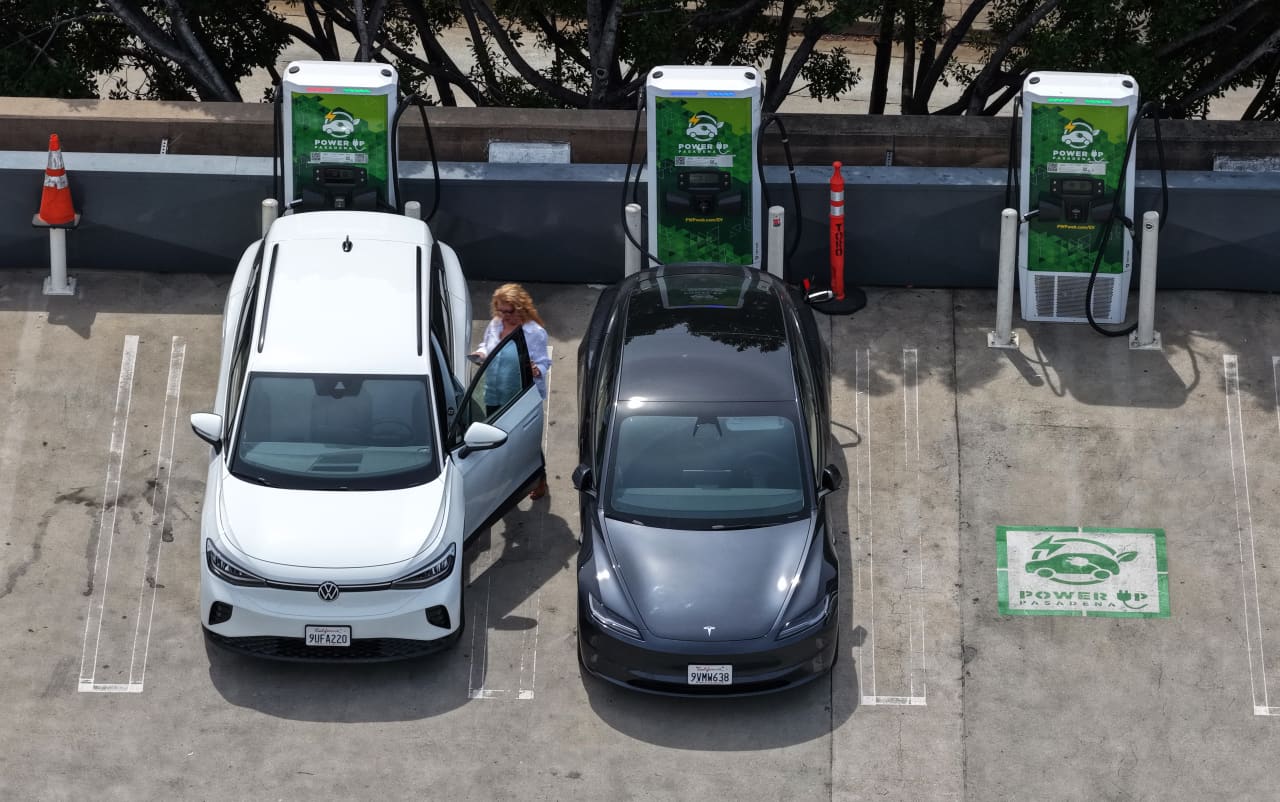
Image via MarketWatch
Carmakers Finally Admit It: Charging Reliability Is the Real EV Battleground
A coalition of major automakers says it has doubled its available charging ports over the last nine months, aiming to tackle the EV problem that owners complain about most: reliable charging that works when and where you need it.
Even with that growth, the group’s footprint still trails Tesla’s network. That gap isn’t just a vanity metric—charging uptime, payment simplicity, and predictable availability are the difference between an EV feeling like freedom and feeling like a part-time logistics job.
The strategic tell here is cooperation. Competitors are teaming up because nobody wants to bankroll nationwide infrastructure alone, and nobody wants to lose customers at the moment of truth—road trips, commutes in bad weather, and “I’m late” mornings when you don’t have time for a broken charger.
🥃 Cole's Take: This is the right fight, and it’s overdue. EV adoption doesn’t hinge on another 0–60 headline; it hinges on boring reliability and a network you can trust like you trust a gas pump. As an investor, I’d focus less on the car badges and more on the picks-and-shovels layer—charging hardware, software, payment rails, and the utilities/grid upgrades that make the whole thing work.

Image via ZeroHedge
Midair Security Shock: Report Says FlyDubai Pilot Stabbed on Dubai–Tel Aviv Route
Reports circulated that a FlyDubai pilot was stabbed during a flight from Dubai to Tel Aviv, with Israeli media describing the incident as being treated as a “full-fledged terror attack.” Details remain fluid in early reporting, but the headline alone is enough to jolt airline security discussions back to the top of the agenda.
When something like this hits, the first-order impact is operational: tighter procedures, potential route reviews, heightened screening, and an inevitable wave of passenger anxiety. The second-order impact shows up in markets and corporate travel behavior—risk premiums move quickly even when facts are still being confirmed.
It’s also a reminder that “geopolitical risk” isn’t an abstract ticker. It shows up in real-world choke points: airports, flight paths, insurance, and the thin margins airlines live on.
🥃 Cole's Take: If you travel a lot, treat this as a cue to get more disciplined, not more fearful: book smart, stay situationally aware, and don’t ignore travel advisories because you’re tired of the news cycle. For portfolios, I don’t chase airline dips on scary headlines—too many variables, too much leverage, too little pricing power. If you want exposure to travel, I’d rather own the higher-quality infrastructure and booking platforms than the planes themselves.

Image via Car and Driver
The 3-Series Keeps Evolving: What BMW Changed for 2027 (and What It Didn’t)
Car and Driver ran a spec-by-spec comparison of the 2027 BMW 3-Series versus the 2026 model, the kind of nerdy breakdown that actually matters if you buy your cars the way you buy your stocks: with receipts and a long memory.
These year-to-year shifts are rarely about a dramatic reinvention. They’re about tightening the package—equipment, trims, powertrain tweaks, tech updates, and the subtle changes that alter resale value and real-world satisfaction more than a press-release horsepower number.
For buyers, the bigger question is timing. Do you grab the outgoing model with incentives and known quirks, or pay up to be early on the refreshed spec sheet with unknown depreciation curves?
🥃 Cole's Take: I love a 3-Series because it’s one of the last “do-everything” sedans that still feels like it was engineered by adults. But I buy cars like I buy businesses: I want the best value, not the newest brochure. Unless the 2027 changes solve a real pain point you care about, the 2026—priced right—often ends up the smarter play.

Image via The Whiskey Wash
Goa, Sun, and a Better Bottle: Indian Single Malts Worth Packing (or Pouring)
If you’re planning a Goa trip and your idea of a vacation bar goes beyond generic duty-free, The Whiskey Wash highlights Indian single malts that deserve a spot in the rotation. Names like Rampur show up for those who like a sherry-leaning profile, alongside more experimental finishes such as mahura.
What’s notable isn’t just the travel angle—it’s the broader quality curve. Indian whisky has been moving from “curiosity” to “credible,” driven by better maturation strategies, bolder finishing choices, and a consumer base that isn’t afraid of flavor.
For anyone who treats food and drink as part of the experience, a local pour can anchor a trip the way a great round of golf anchors a weekend: you remember it because it was specific to that place.
🥃 Cole's Take: If you’re building a holiday bar, skip the predictable labels and bring home something that tells a story. Indian single malts can be fantastic, but they’re not all the same—try before you commit, and don’t get hypnotized by finishing gimmicks. My rule: if it’s balanced neat, it’ll be great with a cigar and even better when you’re watching the sunset with nowhere to be tomorrow.

Image via Robb Report
A Frank Lloyd Wright for $2.1M: The Eppstein Residence Hits the Market
Robb Report spotlights the listing of Frank Lloyd Wright’s Samuel Eppstein Residence near Kalamazoo, Michigan, priced at $2.1 million. Built in 1953, it carries the signature Wright sensibility—structure, light, and a very opinionated relationship with its surroundings.
Homes like this don’t trade like normal real estate. They’re part residence, part stewardship, part art asset. The buyer pool is smaller, the maintenance demands are larger, and the upside depends on scarcity, provenance, and how faithfully the property has been preserved.
Still, there’s a reason people stretch for something like this: you’re not just buying square footage—you’re buying a daily lived experience that can’t be replicated by a new build with nicer countertops.
🥃 Cole's Take: If you can afford the upkeep without sweating your portfolio, a Wright house can be one of the few “luxury purchases” that actually feels like an investment in your life, not just your lifestyle. But don’t kid yourself: the carrying costs and restoration standards are real, and shortcuts destroy value fast. I’d only do it if you’re prepared to be a careful custodian—and if the rest of your balance sheet is already boring and strong.
That’s the Brief. Protect your downside, keep your hobbies funded, and don’t let a good market tempt you into sloppy decisions. I’ll be watching the next GDP prints, the EV charging buildout, and anything in the IPO pipeline that smells like real cash flow instead of storytelling.
— Cole Hargrove