Sponsored By:
Silver surged 144% in 2025 — and with Trump's deregulation clearing the path and Elon Musk eyeing critical material supply chains for Tesla, analysts say silver's next move could be explosive. Even whispers of Musk entering the silver market could send prices skyrocketing.
We created the 2026 Silver Forecast Guide to show you exactly what's driving silver's demand, why the timing is critical, and how to position yourself before the headlines break. Once the market reacts, it'll be too late.
Get the Free 2026 Silver Forecast GuideThis is an advertisement from First Ballot. If you no longer wish to receive promotions from this advertiser, please unsubscribe here. Or write to: 5005 Lyndon B. Johnson Fwy. Suite 350, Dallas, TX 75244.

Live Well. Invest Smart. No Apologies.

Image via RealClearMarkets
Newsom’s $14.3B “tax gift” and the California résumé problem
Gavin Newsom is being framed as the next big national contender, but the California balance sheet doesn’t travel well. The piece argues his record is less “visionary leadership” and more a high-tax, high-cost-of-living experiment where normal families and small businesses keep getting priced out, while homelessness and quality-of-life problems remain stubbornly visible.
The political jab here is that a $14.3 billion tax-related “gift” is the kind of short-term sugar high that looks good in a press release and bad in a long-term ledger. For investors and operators, California’s story has been consistent: talent and innovation on one side, and a regulatory and cost structure that makes permanence feel optional.
If he’s aiming at the White House, he’ll need to explain why affordability got worse while taxes stayed heavy. And he’ll need to do it to voters who are living their own version of “why does everything cost so much?” right now.
🥃 Cole's Take: Markets don’t care about rhetoric; they care about outcomes. If your flagship state can’t keep middle-class families, insurers, and employers comfortable, you’re bringing a vulnerability to a national stage where cost-of-living is the main event. I’d treat any policy platform built on “we’ll spend our way to relief” as a risk factor, not a selling point.

Image via Fox Business
Meta hit with a $25B privacy verdict: the age of “it’s just a fine” is ending
A jury ordered Meta to pay $25 billion after finding it misled users on data privacy, tied to more than 43 million violations of New Mexico’s consumer protection laws. That’s not a wrist-slap; it’s a headline number designed to change behavior, and it signals that states are willing to go big even when Washington moves slowly.
For Meta, the immediate question is appeal, timing, and whether damages stick anywhere near the top-line figure. The bigger question for every ad-driven platform is whether the legal system is now pricing privacy risk the way markets price credit risk: higher spreads, tighter terms, fewer freebies.
If you run a business that depends on data, the compliance burden is about to feel less like “lawyer stuff” and more like operating expense. And for investors, this is a reminder that regulatory risk can re-rate a cash machine faster than a product misstep.
🥃 Cole's Take: I don’t own platforms on the assumption that fines are a rounding error anymore. The smart trade is to separate “engagement engines” from “trustworthy stewards” and pay up for the latter. If Meta ends up settling or winning on appeal, fine—but the direction of travel is clear: privacy liability is becoming a core valuation input.
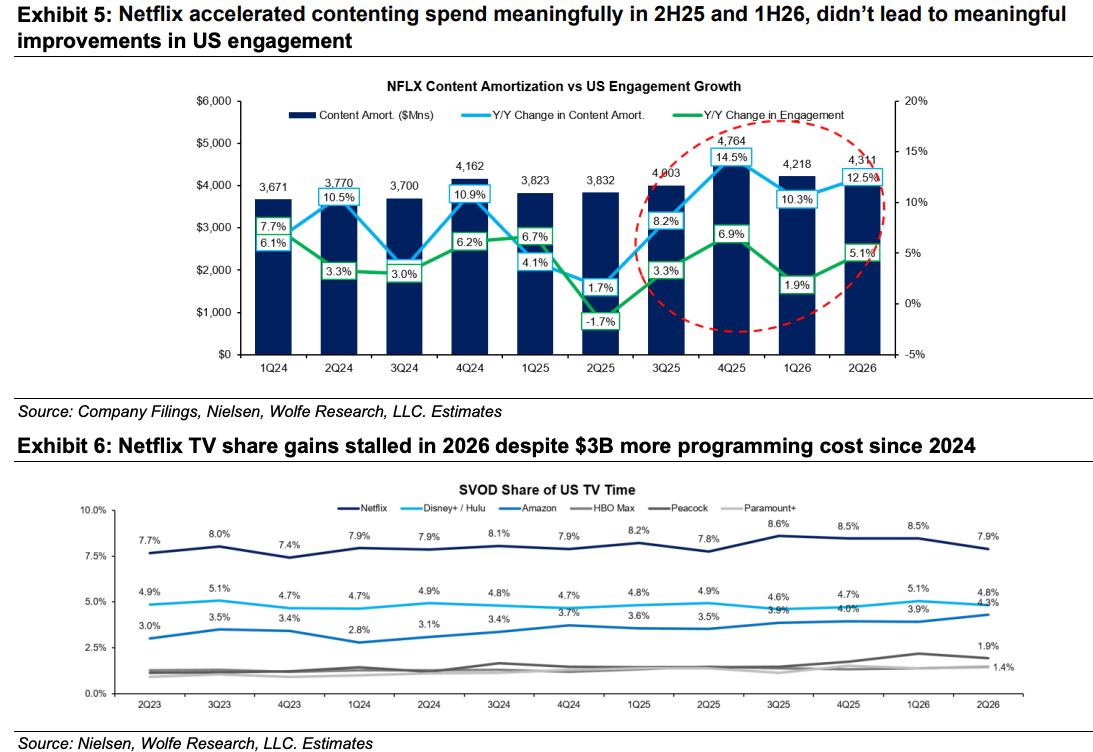
Image via ZeroHedge
Netflix gets the dreaded note: spending isn’t the same as hitting
Wolfe Research downgraded Netflix, arguing the company has “lost its mojo” as billions in content spending fails to consistently deliver hits. The critique isn’t that Netflix can’t make good shows—it’s that in a saturated streaming world, the hit-rate matters more than the total spend, and the market is less willing to assume every dollar turns into subscriber love.
This is the streaming endgame: everyone has content, everyone has an app, and differentiation gets expensive. When the narrative shifts from “dominant platform” to “hit-dependent studio with a subscription wrapper,” the multiple can compress even if the business remains profitable.
If Netflix has to spend more to keep churn down, margins become a debate again. And when Wall Street starts sniffing around for “creative fatigue,” the stock stops trading on inevitability and starts trading on proof.
🥃 Cole's Take: I like Netflix when it’s priced like a compounder, not when it’s priced like it can’t miss. Content is a treadmill, not a moat, and the market is finally acting like it remembers that. If you own it, watch free cash flow and churn like a hawk—those numbers will tell you who’s right faster than any analyst note.

Image via Car and Driver
AMG goes smarter muscle: the 2027 GLE and GLS get sharper tools
Mercedes-AMG is updating the GLE and GLS performance SUVs for 2027, and the changes are telling. The GLE53 moves to a plug-in hybrid setup, while the GLE63 S and GLS63 get a quieter but meaningful hardware shift with a flat-plane crankshaft, aimed at delivering a more refined, responsive punch.
This is where performance is headed: less about noise and more about usable torque, smoother power delivery, and tech that makes speed feel effortless. Plug-in hybrid in the GLE53 also fits the real-world pattern—short daily driving on electrons, long-haul flexibility when you’re not planning your life around chargers.
For buyers in this bracket, the question isn’t whether it’s fast; it’s whether it’s fast without being obnoxious, and whether it feels special at 7 a.m. on a school run and at 7 p.m. pulling into a steakhouse.
🥃 Cole's Take: The best luxury performance now is “quiet competence,” and AMG seems to get it. A PHEV GLE53 is a smart move for people who want muscle but also like visiting the gas station less often. If depreciation is your concern, buy the spec you’d still love in three years—because the tech cycle is speeding up and yesterday’s halo features become tomorrow’s baseline.

Image via Robb Report
Nantucket’s $32M Greek Revival: old bones, new money, and the lifestyle premium
A restored Greek Revival home on Nantucket’s Main Street, dating to the 1830s, is listed at $32 million. The story leans into the pedigree—historic presence, modern updates, and a claim to the island’s first swimming pool, the kind of detail that turns a nice house into a conversation piece.
This is trophy real estate, and trophies trade on scarcity, narrative, and location more than cap rates. In a world where remote work and flexible calendars haven’t disappeared, the top end still attracts buyers who are effectively diversifying into experiences: walkability, legacy architecture, and a summer address that signals you’ve arrived.
But the same forces that make Nantucket desirable—limited inventory and strict rules—also mean upkeep and renovations are slow, expensive, and political. You’re not just buying a home; you’re buying into a small ecosystem.
🥃 Cole's Take: If you’re paying $32 million, don’t pretend it’s an “investment property”—it’s a lifestyle asset with optionality. The right way to underwrite this is: will you use it enough to justify the carrying costs, and would you still want it if prices go sideways for five years? If the answers are yes, the premium is the point.

Image via Outside
Hiking’s real dividend: what your body cashes in on out on the trail
Outside breaks down what happens to your body when you hike, and it’s a long list of benefits that compound over time. You’re getting aerobic work, muscular endurance, better balance, and joint resilience—especially on uneven terrain where your stabilizers are forced to earn their keep.
There’s also the quieter stuff: stress reduction, mood lift, and better sleep, which is the kind of “health alpha” most guys underestimate until they feel it. Hiking is sneaky that way—it’s not a heroic gym session, but it’s repeatable, sustainable, and it plays well with real life.
For anyone sitting at a desk too long or traveling too much, hiking is a simple lever: load a pack, find a climb, and let your cardiovascular system remember what it was built for. You don’t need fancy gear; you need consistency and a little humility on the uphill.
🥃 Cole's Take: Hiking is one of the few activities that pays you back in multiple currencies: fitness, headspace, and longevity. If your calendar is packed, schedule trails the way you schedule meetings—non-negotiable. The best portfolio is useless if you can’t carry your own bag through an airport or enjoy the view when you finally get there.
📎 Outside
That’s the brief. Protect your downside, stay liquid enough to move when opportunity shows up, and get outside before your week disappears into screens. I’ll be back with the next set of angles worth your attention.
— Cole Hargrove