Nuclear energy stocks surged 40%+ this year as the next buildout cycle accelerates toward 2026. One uranium producer just generated nearly $200 million in quarterly free cash flow, while other nuclear companies locked in massive government contracts—all driven by real earnings and exploding demand as U.S. capacity is projected to triple.
Our analysts identified 7 nuclear stocks positioned to capitalize on this trend right now. Some offer explosive upside tied to uranium prices, others provide steady growth from infrastructure contracts. Get the complete list with names and tickers free today—but this report moves behind the paywall soon.
Get the Free ReportBy clicking the link above, you will get this free report and a free subscription to MarketBeat's daily email newsletter. You are also agreeing to the terms of our privacy policy. Unsubscribe at any time.

Live Well. Invest Smart. No Apologies.

Image via RealClearMarkets
The Managerial Revolution Is Reversing — And Your Portfolio Needs to Notice
James Burnham's 1941 book The Managerial Revolution predicted the rise of a professional class that would control capital without owning it — the MBA armies, the consultants, the process architects who built empires on other people's money. For eight decades, that prediction held. Corporations got bigger, more complex, more dependent on layers of management to function. The people who owned the shares became distant from the people who ran the show.
Now that age is ending, and for the exact reason it began: efficiency. Technology — AI, automation, decentralized networks — is making middle management obsolete faster than anyone expected. The same force that created the need for managers in the industrial age is now eliminating them in the digital one. Companies are flatter, faster, and increasingly run by founders who never left or operators who think like owners.
This isn't just corporate theory. It's a shift in where value lives. The businesses winning today are lean, founder-led, and allergic to bureaucracy. The ones losing are still paying six-figure salaries to people whose job is to schedule meetings about meetings.
🥃 Cole's Take: If you're still heavy in legacy blue-chips with bloated overhead and no founder vision, you're betting on the past. The next decade belongs to companies that look more like startups and less like governments — and that's where I'm allocating.
PepsiCo's Uncertainty Problem Is Everyone's Problem
Markets hate uncertainty, and PepsiCo just delivered a masterclass in why. The company's recent earnings and guidance left more questions than answers — soft demand, pricing pressure, mixed signals on international growth, and a consumer base that's pulling back on discretionary snacks and beverages. Wall Street responded accordingly: down and nervous.
What's happening at PepsiCo isn't unique. It's a canary in the coal mine for consumer staples. Middle-income spending is weakening. Premium products are holding up, budget options are moving, but the middle is getting squeezed. PepsiCo lives in that middle, and right now that's a hard place to be. The company is trying to navigate inflation, shifting consumer habits, and a global economy that's slowing in some regions and stalling in others.
The uncertainty isn't just about PepsiCo's operations — it's about whether the consumer is tapped out. If a company that sells soda and chips can't find solid footing, what does that say about the broader retail environment heading into the back half of 2026?
🥃 Cole's Take: I'm not rushing to buy consumer staples here. The middle-market squeeze is real, and companies like PepsiCo are stuck between a rock and a hard place until consumer confidence returns — and I don't see that happening before Q4 at the earliest.

Image via Yahoo Finance
Target's Real Problem Isn't What You Think
Target's struggles are being blamed on everything from theft to merchandising missteps, but the real problem is simpler and harder to fix: they're losing their customer. Target built its brand on being the upscale alternative to Walmart — better design, cleaner stores, a shopping experience that didn't feel like a chore. That customer still exists, but she's spending differently now, and Target hasn't kept up.
The company is caught in no-man's-land. Walmart is beating them on price and convenience. Amazon is beating them on speed and selection. Specialty retailers are beating them on curation and experience. Target's response has been to try to be everything to everyone, which is another way of saying they're not essential to anyone. Their private labels aren't strong enough, their digital integration isn't smooth enough, and their stores feel stuck in 2019.
The deeper issue is that Target's core customer — the suburban mom with disposable income — is under financial pressure and changing her habits. She's buying less, trading down where she can, and when she does splurge, she's going direct to brands or specialty shops. Target's value proposition used to be clear. Now it's murky.
🥃 Cole's Take: I wouldn't touch Target equity until they figure out who they're actually serving. Retail is unforgiving right now, and being in the mushy middle is a death sentence. They need to pick a lane and own it, or they'll keep bleeding share to everyone around them.

Image via Golf.com
Royal Birkdale Returns — And It's Not the Course Spieth Tamed
The Open Championship is back at Royal Birkdale this week, and if you remember Jordan Spieth's dramatic win in 2017, forget it. This isn't the same test. The course has been reworked, lengthened, and the rough is meaner than it was nine years ago. Birkdale has always been considered the fairest of the Open venues — fewer blind shots, more room off the tee, less of the chaos that defines links golf — but fair doesn't mean easy.
What makes Birkdale special is that it rewards strategy over luck. The dunes funnel play into corridors, the greens are firm and fast, and the wind off the Irish Sea can turn a five-iron into a rescue club in the span of an hour. It's the kind of course where you have to think three shots ahead, where positioning matters more than power, and where patience wins over aggression. In other words, it's a course for people who actually understand golf, not just hit it far.
I've played Birkdale twice, once in dead calm and once in a gale that made me question my life choices. Both rounds taught me more about course management than any lesson ever did. If you've got the means and the interest, this is the Open to attend. Birkdale in July is about as good as golf gets.
🥃 Cole's Take: I'm booking flights. Birkdale is the rare Open venue where you can actually watch golf without losing sight of the players in a valley. Plus, Southport in July beats sitting at home watching on a screen — and the whiskey is better in person.
📎 Golf.com
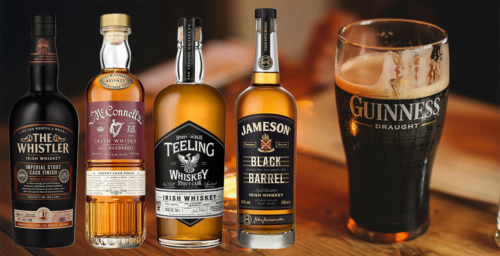
Image via The Whiskey Wash
Four Irish Whiskeys That Actually Belong Next to a Guinness
There's a reason the Irish have been pairing whiskey and stout for centuries — it works. The creamy, roasted notes of a proper Guinness set up a smooth Irish whiskey perfectly, each sip resetting your palate for the next. But not every whiskey plays nice with a pint. You need something that complements the stout without fighting it, something smooth enough to sip but complex enough to stand on its own.
The list here is solid: Redbreast 12 for richness, Powers Gold Label for everyday ease, Green Spot for a fruity counterpoint, and Teeling Small Batch for something a bit more adventurous. These aren't high-proof monsters or overly peated outliers — they're balanced, approachable, and built for the kind of slow evening where you're not rushing anywhere. The key is to sip the whiskey between pulls of the stout, not chase one with the other. Let them have a conversation.
I'd add that this pairing works best when you're not overthinking it. Good whiskey, fresh Guinness, no pretense. If you're in Ireland, even better. If you're not, pour both at home and pretend you are. The ritual matters as much as the drink.
🥃 Cole's Take: I keep Redbreast 12 and Powers on hand for exactly this reason. It's one of the simplest, most satisfying pairings in the spirits world, and if you've never tried it, you're missing out on one of life's better small pleasures.

Image via Outside
16 Days in the Grand Canyon: The Gear That Earned Its Weight
Two-plus weeks rafting the Colorado River through the Grand Canyon is the kind of trip that separates essential gear from dead weight fast. You're off-grid, in the elements, covering 226 miles of river with no resupply and no bailout options. What you pack on day one is what you live with until day sixteen, and every ounce matters when you're hauling dry bags in 110-degree heat.
The lessons here are universal for any serious backcountry trip: pack for durability, not novelty. The gear that earned its spot included a high-quality dry bag, a wide-brimmed sun hat, a reliable water filtration system, and a camp chair that actually supported a full day of sitting on sand. The dead weight? Extra clothing that never got worn, gadgets that seemed smart at home but were useless on the river, and anything that tried to do two jobs poorly instead of one job well.
The luxuries that made the cut — a good headlamp, a packable pillow, a quality knife — weren't luxuries at all by day three. They were necessities. The Grand Canyon teaches you to respect your gear and to know the difference between what you want and what you actually need. That's a lesson that applies to a lot more than packing.
🥃 Cole's Take: I've done enough backcountry travel to know that the best gear is the gear you forget you're carrying because it just works. If you're planning a serious outdoor trip, read this list twice and pack once — your back will thank you.
📎 Outside
Now if you'll excuse me, I've got a tee time and a Redbreast waiting. — Cole
— Cole Hargrove